

Veronique Deblois, CTIE
“A person’s strength, if overused, can become a weakness.” ~ John Geier, inventor of the DISC Assessment Systems.
This white paper focuses on helping travel agencies and their staff to understand their strengths better so they can, in turn, better understand travelers based on a behavioral assessment test known as DiSC. With DiSC, behavior types are divided into four classifications: Dominance, Influence, Steadiness, and Conscientiousness.
The DISC Profile, which later led to John Geier’s DISC Assessment Systems, was first defined in psychologist William Mouton Marston’s 1928 book, “Emotions of Normal People”. According to Marston’s theory, behavioral expression of emotions could be categorized into types (Dominance, Inducement, Submission, Compliance), based on a person’s perceptions of self in relation to his or her environment. He believed that understanding one’s primary behavioral trait would help understand and manage one’s experiences and relationships with others [1].
Behavior can be taught. We can learn to adapt our behavior to be more effective. This is a critical concept for travel agencies and their staff to understand in order to increase sales with various client types.
As a travel agent, is your selling technique different based on the type of customer you are helping or do you have one style and approach for all travelers who come to you for help? Do you wonder why some customers are receptive to you and some just aren’t? Using a DiSC assessment test could help answer that question and in turn, help sell more trips.
DISC, much like other behavior or personality assessment tools, works by helping its users become more self-aware. This self-awareness helps with understanding and accepting the strengths and weaknesses in oneself and in staff and clients.
The key reasons to participate in DiSC Assessment Testing:
- Increase self-awareness
- Recognize behaviors in colleagues and customers
- Take advantage of strengths and reduce negative impact of weaknesses
- Improve overall relationships, both personal and professional
The content of this white paper will help in multiple ways but specifically with two core principles: aid you understand where on the DiSC spectrum you fall and, assist you to evaluate where on that spectrum your clients fall so you can better adapt your selling pitch accordingly.
Table 1 following offers a concise view of the four quadrants of DiSC styles and their impact on personalities. Using the table, it is simple to understand how outgoing or reserved, how a task or people-oriented a person is based on his/her DISC Assessment.
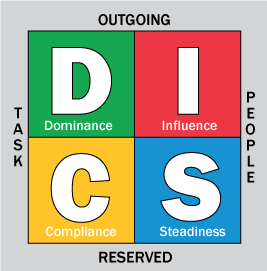
Source: Disc Profile Training, in Action Coach Business Coaching,
DISC Styles Breakdown
As previously discussed, DiSC behavior types are divided into four classifications: Dominance, Influence, Steadiness, and Conscientiousness.
Dominance – (D)
The D Style
We begin with Dominance not because that is what my style is but because we often think of pushy “salesman” when considering the behavior of sales people. The style of a (D) person is to be very confident and direct. (D)s love a challenge, getting things done and seeing immediate results.
I once worked for a sales-driven person who took self-assurance to the next level. We often called his personality ‘very New York’ as he was forceful, blunt, fast-paced and driven (traits I share with him). We once called on a travel agency in the Midwest with laid back leadership who was ultimately turned off by my boss’ in-your-face demeanor. We initially lost the sale but were given a chance to send a rep who was like-minded and who understood their position, used patience and could relate his sales pitch to them, winning us the contract.
The D Travel Agent
Travel agents who are (D)s can be argumentative and not listen to what their clients request, which can be a detriment. Conversely, these decisive agents can often time be what indecisive clients are seeking. They will be confident in presenting trip information and their winning personalities will close sales.
The D Traveler
When working with a (D) style client, travel agents should avoid over-explaining various trip scenarios and offering details that are too granular in scope. These types of customers want to get straight to the point, want immediate results and lack patience – the focus should be on business instead of social topics.
D Fit at a Travel Agency
(D) people think about big picture goals, concrete results and the bottom-line so they are good targets for team-leadership and management duties. They want to see results and will drive for them to be delivered within specific time frames.
[divider align=”center” width=”300px”]
Influence – (I)
The I Style
The style of an (I) person is to be very outgoing and optimistic. (I)s value openness, team building and forging relationships. These folks thrive on social recognition and dread disapproval or criticism.
The I Travel Agent
A travel agent who is an (I) needs to research all the facts about a trip then make concise, persuasive, candid recommendations to their clients. Some, in their enthusiasm and longing for approval, might not be perceived as true subject-matter-experts by clients.
The I Traveler
Clients who are (I)s can lack clear focus which can be difficult in assessing what their trip requirements are. Travel agents working with this type of client need to, in a friendly way, ask concise, direct questions to keep answers focused.
I Fit at a Travel Agency
(I) travel agents excel in situations when they can be the presenters or pitch persons – the ones who drives interest with the clients but who ultimately need a partner within the agency to handle the details. These agents could be great candidates to lead the marketing and social media efforts of the agency. They can positively influence clients to visit the agency or inquire about a trip in a fun way that appears to be low-pressure.
[divider align=”center” width=”300px”]
Steadiness – (S)
The S Style
The style of an (S) is to be collaborative and sympathetic. The (S) person tends to want to work with others as a team to carry out tasks. This person is genuine, dependable, honest and values cooperation from his/her peers.
The S Travel Agent
Travel agents who are (S) are calm, patient and excellent listeners, a trait critical in the business. (S) are not fond of being rushed or pressured by clients, so working with (D) customers could be an issue.
The S Traveler
Clients who are (S) are often not open to change, so being pushy about selling them into an unknown destination could a roadblock. Having said that, these folks are consistent so perhaps they are cruisers who will be open to cruises to a different destination. The key is to be patient with this type of customer.
S Fit at a Travel Agency
(S) travel agents are acquiescent towards authority and are loyal team members. The (S) agent is also good at multitasking and enjoys repetitive duties. These agents could be good corporate account bookers where ticketing air and hotels are often times repetitive tasks. Think of group sales with these agents as their calmness and patience would be key assets with groups.
[divider align=”center” width=”300px”]
Conscientiousness – (C)
The C Style
The style of a (C) is to be accurate and precise. These are detail-oriented people who make decisions judiciously with abundant research and information to back up these decisions.
The C Travel Agent
This group is passive and tries to avoid conflict, if at all possible, so it is critical they do not become bullied by aggressive clients, (D)s.
The C Traveler
Clients who are (C) are not quick decision-makers. They like to have detailed information about their trips prior to selecting the best option for them. A travel agent would need to use a great deal of patience with (C) clients in order to make a sale. It is best to be prepared with in-depth research when selling to a (C).
C Fit at a Travel Agency
(C) travel agents, being very detail-oriented, could be great at administrative work and would ensure all tasks are done properly, to completion. Travel agents who are (C) work well independently seek out peaceful work environments and thrive to maintain stability thus making them great candidates for a work-from-home business model.
More on Traveler Personality Styles
The D Traveler
- Habitually books travel close to departure time, often the day before
- Does online searching so will know what the deals are and will try to dominate the conversation with agents
- Same day trips are preferred
- Airline/hotel/rental car status is important
The I Traveler
- Love the hustle of airports
- Wants to visit airport lounges to “hang out” with everyone
- These are not pack-light, carry-on only travelers as they will want to bring back gifts and souvenirs. They will want to entertain clients after meetings, so being in areas that have trendy restaurants and bars are a must
The S Traveler
- Purchase their airline tickets far in advance
- Have an agenda for their whole trip
The C Traveler
- Creates a budget, and often times spreadsheets, to determine vacation budget
- Prefers to compare prices online prior to visiting an agent
- Not fond of crowds and the lines so car rental and hotel check-in bypass tools are appreciated
- TSA Pre-check membership is critical and air reservations should reflect that
Encouraging DiSC Assessment Testing to Increase Sales
Based on the many earlier examples, it is likely clear what your own DiSC assessment is. When I read the lists of the behaviors of a (D), it is almost comical to see so many of my traits described.
Encourage travel agency employees to complete a DiSC Assessment Test to determine what their personality styles are. Urge them to share their DiSC styles are with colleagues, as it will help your team:
- Learn about each other and how they each deal with conflict, what motivates them, what stresses them out and how they problem solve
- Develop stronger team collaboration
- Lessen team conflicts
- Ultimately, increase sales by categorizing client personalities and behaviors and responding to them in a more scientific way
A basic, free version of the DISC assessment is available at www.discpersonalitytesting.com when you sign up for an account.
Attributions and Sources
[1]: “History of DiSC,” from https://www.discprofile.com/what-is-disc/history-of-disc