

Malgorzata Musial, CTC
The most significant is the true understanding of employee diversity and how a collaborative relationship addressing individual groups contribute to the cohesive result of the organizations productivity. We need to recognize how important individualism is in job performance and why the collective group needs to identify the diversity among each employee. If achieved properly in all it can contribute positively to business productivity, collaboration and be the organization’s competitive edge. The recognition that strength within a diverse organization contributes to customer satisfaction. The more satisfied the customers are, the stronger longevity of the relationship between the customer and the organization. Building the right vacation package for example, sometimes will show them the value of my service as a travel consultant. By providing the customer with a level of satisfaction can and will ensure that they will come back to me for all future bookings. Diversity is a plus in reference to my own background. I was born and raised in Poland. I have visited many countries in Europe, such as Spain, Italy, Russia, Great Britain and France. Working here in America has been a wonderful experience in relation to working with all types of people and various customer’s whom could be considered high net worth to someone who only takes vacation once every three years. As a seasoned travel consultant, I have to remember to qualify and meet all family member’s preferences and needs such as their age, special interest, expectations, budget, preferred accommodation, and most important the type of required amenities. Over all I have to be a great listener in order to respond to needs of my clients and expand or offer new solutions in order to create and exceed their expectation’s. In today’s business environment and atmosphere in reference to reviews and comments referring to social media and various applications the pressure is always on to provide excellent service. Every client is different and has their own travel motivation in which I have listed below:
1) Exploring new destination
2) Seeking authentic experiences
3) Rest and relaxation
4) Personal enrichment
5) Spending time with or reconnecting with love ones.
Once I have identified what motivations my client’s wants and needs are, my own diversity as well as theirs is a true learning and teachable moment no matter who is sitting across from desk, I will be able to create the most memorable vacation package for the entire family or individual. Diversity is also important during the communication process in the early stages of planning a trip, rather that takes place by phone or email or my most favorite in person. As a travel consultant I need to remember to always respond properly and most importantly respectfully. Respect is important just as the person who may sit across from me. Know two vacations are alike, so I never take for granted rather its woman or man or someone whom may be traveling to a new country for the first time or who may have religious differences or a background that may differ from mine. The world is a very big place with seven continents and vast oceans that may separate us, we are all here on the same planet and that’s what makes us all special and unique. I truly became a travel agent because I love working with everyone and most importantly all different types of people. So not only is diversity important to me I truly embrace it with open arms, because we all can learn something from one another’s diversity, and we must all in my opinion work together just as we all travel together on a daily and global basis.
One of the main tools helping me personally to be more successful in my career and working with the public was a DISC personality styles study I took during my CTA course.
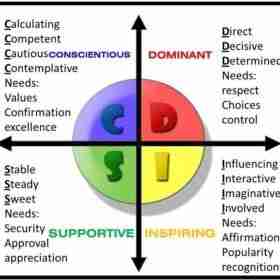
“Positive Personality Profiled” R.Rohm
After reading study materials, and referring back to it occasionally has helped me as a gender and diversity tool in order to identify personality types and traits. There is no such thing as a one size fits all when I have referred to the text, but it has led to have a better understand of some of my client’s needs and selling better, or recommending the right product when closing a sale. I think it is important to take time and study DISC personality styles and types. This knowledge not only will help you meet the client’s needs better, but sell better. That will also benefit you with managing projects and building successful team. We need to remember we all are different people, we do react differently to situations and we have different strengths and weaknesses. Being able to recognize this, has somewhat qualify me to provide a higher level of customer satisfaction and remain successful within my organization.
Many behavioral models focus on what is wrong with a person to identify “personality disorders.” The DISC model is based on normal behavior, not abnormal behavior. DISC is a “wellness model” that is objective and descriptive rather than subjective and judgmental. Therefore, DISC is a practical way to understand yourself and those around in the common settings of everyday life. We apply the DISC personality model with four main ideas that allow it to be used appropriately as an effective and encouraging tool:
1. We use a positive approach to highlight and encourage a person in his or her strengths.
2. We use a positive approach to address a person’s possible blind spots without assuming a weakness exists.
3. We recognize that each person has a unique blend of all the major personality traits to a greater or lesser extent.
4. We recognize that behavioral patterns are fluid and dynamic as a person adapts to his or her environment.
I heard a saying that, “your strengths should carry you while your blind-spots should concern you.” Being able to identify and articulate your strengths can be very empowering. Being able to identify and uncover blind-spots can also be very empowering. Also ability to understand yourself and others for effective communication and teamwork. Studies have shown that technical skill, beginning with intelligence and developed through education and experience, accounts for only 15% of success in the workplace. The other 85% of workplace success comes from people skills! These skills are developed through learning better ways to behave and interact. (Robert A. Rohm, Ph.D)
There are 4 basic steps in learning how to work with other people:
1. Learn about the DISC Model of Human Behavior
2. Take a personality assessment (personality test) to determine your exact personality blend and personality profile
3. Study material that teaches you how to read and understand the personality of another person.
4. Study material that teaches you how to adapt yourself to work better with others. (“Positive Personality Profiles” R.Rohm)
Different is not bad, it is just different! A lack of understanding of ourselves and others can lead to real problems such as tension, disappointment, hurt feelings, unmet expectations and poor communication. And we all know, it is hard to work with a problem, especially if you do not understand what is going on inside the mind of another person. Human behavior is not cut and dry, or black and white, which is why DISC theory consists of a combination of four DISC personality styles. Taking into account someone’s personality traits allows us to see the unique blend of their DISC personality types and how this affects their everyday actions, personal preferences within different environments, communication with other, ability to organize, reactions and avoidance of conflict, and more. By understanding someone’s DISC personality blend, we can take proactive steps to placing that person in environments where they will react positively, and better understand and predict their actions and reactions in general. Using this technic travel agents can provide customers with surprising insights about how they can save money and experience unforgettable vacation. The travel agents can tailor their message to client’s specific needs. They can be assertive, they can push back when necessary or take control of the sale.
Organizations embracing DISC may benefit from improved communication, less misunderstanding, shorter meetings, less conflict, effective teams, more cooperation, more productivity, and improved financial performance. Listed below key areas where DISC is particularly useful:
1. Business, HR
2. Training, Consulting, Coaching
3. Ministry
4. Education
5. Developing leaders
6. Team development
7. Salesforce development
8. Customer service training
9. Conflict management
10. Job and career coaching (“Positive Personality Profiles”Robert A. Rohm, Ph.D)
The DISC personality test, based on Marston’s DISC theory, has been used in business and personal application for over 30 years. The DISC Theory research that Marston conducted in the 1920’s continues today to give us great insight into human behavior and DISC personality types. The most important is the DISC focuses on behavior not emotions. DISC does not have right or wrong, good or bad styles. It is pointing out that all styles have strengths and limitations, and all styles are uniquely positive. We still need to remember that DISC can be applied to life. It has practical and useful applications in social, business and family relationship, and is a great tool for self-development. Success starts the minute we understand the life means growing, gaining new knowledge and skills every day. Our learning process never ends and it is up to us to be open to new possibilities, risks to create successful career. (“Even Eagles Need a Push” David McNally).
One of the dangers of learning about DISC is that you may think you now understand all there is to know about it. The starting point of understanding people is to realize and accept one simple fact: Everyone is not like you! (“Positive Personality Profiles” Robert A. Rohm, Ph.D). To feel a gap and avoid dangerous effect: “I know everything” we need to use diversity training and management. As diversity definition states the recognition of cultural differences among individuals who originate from various countries of origin and have individualistic ethnicities, attitude, beliefs, that contrast. (“Diversity, inclusion and commitment in organization” Mor and Barak, Findler, & Wind, 2001). The concept of diversity encompasses acceptance and respect and it means understanding that each individual is unique and recognizing our individual differences (“Managing diversity” Carr-Ruffino).
I think diversity training should be at the cornerstone in relation to importance within every company. Diversity training addresses such fundamental issues as change, communication, gender at work and conflict resolution. Diversity is strength.
Terms and Definitions:
Diversity – is the recognition of cultural differences among individuals who originate from various countries of origin and have individualistic ethnicities, attitude, beliefs, that contrast. (Barak, Findler, & Wind, 2001).
Ethnicity – is an ethnic group a social group that shares a common and distinctive culture, religion, language or the like.
Diversity management – is the “recognition and valorization of individual differences”. The concept of diversity encompasses acceptance and respect. It means understanding that each individual is unique, and recognizing our individual differences (Carr-Ruffino,1996).
Bandura’s (1977) Self-Efficacy theory includes the framework of how a person’s beliefs contribute to their level of competence related to work, relationship and interactions with others.
References:
Carr-Rufino, N. “Managing diversity”, 1996
McNally, D. “Even Eagles Need a Push” 1990
Mor Barak, M.E, Findler I., & Wind I.H. “Diversity, Inclusion and Commitment in Organizations”, 2001
Rohm, R.A., Ph.D. “Positive Personality Profiles”, 2005