

Elizabeth Evert, CTC
Many of us know someone who, despite being considered elderly by age, remains physically active, mentally sharp, and capable. We also know others in this same age group who may need extra assistance, particularly with travel arrangements. For travelers over 65, a great experience often requires careful attention to details that we might not always consider on our own. In this paper, I aim to provide insights into effectively selling travel to this unique demographic.
According to the US Census Bureau the number of Americans ages 65 and older is projected to increase from 58 million in 2022 to 82 million by 2050 (a 47% increase), and the 65-and-older age group’s share of the total population is projected to rise from 17% to 23%.[1]
However, not everyone classified as elderly by the US Census Bureau requires additional considerations when planning, or traveling, for a vacation. Many older adults can manage these tasks independently with only occasional reminders to stay on schedule and keep to their itinerary [2]. As travel agents, we need to take extra care to assess the needs of these travelers thoroughly and approach this demographic of travelers with sensitivity to avoid causing undo discomfort or offense. For example, instead of assuming limitations, you might say, “I noticed this tour is rated as a level 3, which includes some walking, but the guide will offer breaks during the tour. How far do you feel you can comfortably walk before needing a break?” This allows them to share their capabilities without feeling stereotyped while also feeling cared for. Also, inquire about other specific needs, such as frequent bathroom breaks, and make sure to tell them that the bus may not have a restroom on board. Others may also need more physical assistance with tasks like hygiene, meal preparation, and dressing. They may also have medication needs that necessitate administration by a trained medical professional or a trusted travel companion, along with reminders to ensure these tasks are completed. With all of this in mind, it can be challenging to determine these needs through phone, email, or text, so a careful and respectful conversation is not only essential but vital. reminders to ensure these tasks are completed. With all of this in mind, it can be challenging to determine these needs through phone, email, or text, so a careful and respectful conversation is not only essential but vital.
Previous research has identified aging as a problem associated with the decline and loss of physical and psychological health in later life. Several studies have noted that tourism positively affects seniors’ subjective well-being and level of social engagement by enhancing their self-esteem and confidence. Given the potential for active aging to generate positive improvements in the overall health of seniors. This also includes their physical and mental health and activities that stimulate active aging, including tourism, which has emerged as an important research area in factors related to seniors’ health. [3]
Elderly individuals are enthusiastic about traveling, and it’s crucial for travel advisors to cater to their specific needs, which can differ significantly from those of younger age and middle-aged travelers. Travel is good for our brains.[4]
Each time we take a trip, there are mistakes and problems that come up, it’s unavoidable sometimes. At home, we might just whine and complain, but when we are in a foreign country, and we are experiencing such glitches this poses new challenges. With this said, it has become challenging at times to assess if a traveler needs extra consideration. When communication begins it is usually through a means other than face to face and this alone makes things a bit of a challenge to create a response that identifies and answers the concerns of the traveler while providing them the best tour and pricing for them.
When I first started my career in travel after graduating from a Hospitality and Travel Agent Community College course in 1980 people didn’t call travel agencies as often as they would simply drop by to say “hi” and browse the exciting travel brochures on display. It was our responsibility as agents to approach these potential clients personally and engage in conversation and build relationships, hoping to turn them into repeat customers. And if we connected well in person, it usually led to a sale. These social interactions allowed us to listen and learn about their past travels, what went wrong, and what they wanted to change. We were more skilled at identifying and meeting clients’ needs because we interacted with them in person most of the time. There were no smartphones, and the internet was just beginning to develop as a source of information, available only to those with home computers.
Additionally, these face-to-face meetings allowed us to observe and address any difficulties potential clients might have had with reading or understanding written or spoken information, without making them feel self-conscious.
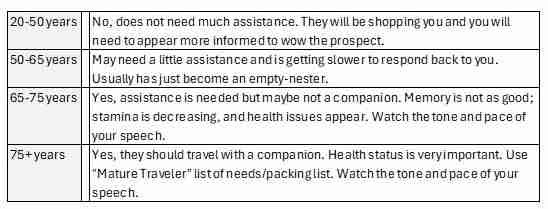
Today it’s challenging to tell if a prospective client is an older adult over the phone, or via email and text. But there is one simple habit I have gotten into that seems to work by simply advising the prospective traveler in order to give an accurate quote and to make sure they take advantage of all the possible discounts that could be available to them/ I typically say, “I will need a little more information, Are you active in or retired from the military? Do you have an AARP or AMAC number? What’s your birthday? Are you celebrating any special occasion?” The birthday question is what I am after because I will at least know their age without having them be embarrassed to tell me. I then refer to the following chart when I begin my trip search and quote.
Always treat elderly people with respect and kindness, acknowledging their feelings and avoiding any behavior that makes them feel outdated or irrelevant.
Tips for communication [5]
- Speak clearly and articulate your words and make eye contact. Older adults may have trouble hearing. Speak while looking directly at the person’s face — not to their side. Move your mouth and pronounce each word carefully and precisely. Many folks have developed lip reading and fake smiling that makes it look like they heard you.
- Be mindful of the environment you are talking in. If you have access to a quite area with some chairs move in that direction. If there are too many interruptions or distractions, they will lose their thoughts. Ask the older adult if the environment is comfortable for them.
- Ask clear and precise questions. Do not hesitate to repeat or rephrase your sentences and questions if you think there is a lack of understanding.
- Avoid the confusion of mixed ideas and questions. Try to define your ideas and questions logically. If you mix ideas, it may be confusing for the older adult to understand. Express one idea and message at a time. For example, “Do you like to eat dinner at 6:30pm? (pause) or 8:30pm”? A more complicated sentence would be “You have a choice between dining at 6:30pm or 8:30pm, which time would you like?”
- Use visual aids such as the brochure if available or attach one to your email. If I attach one to an email, I say something like, “Sometimes I have trouble opening things in my emails, I have to ask a friend to do it”. This makes them feel like it’s ok to have trouble.
- Be patient and smile. A sincere smile shows that you are a kind person. It also creates a friendly environment. Remember to pause between sentences and questions. Give the person an opportunity to understand information and questions, be compassionate. When you pause, you show respect and patience.
When you ask how many people are traveling, if they say two, request the contact information for the other person. Suggest a conference call or a meeting at their favorite coffee shop before any money is exchanged.
To clarify, not all older adults experience these issues. Many seniors are in excellent mental and physical health. Use these steps only if you notice the older adult has difficulty communicating; otherwise, you may unintentionally offend them, and we want to avoid this!
In closing, as travel agents, our days often feel like we’re on a speeding train going round and round to nowhere, with calls coming in, on hold, all while feeling the urgency of getting back to potential customers hoping for the sale while sitting under a pile of notes and it can be overwhelming! When you get that call and realize there’s an older gentleman on the other end remember to relax, take a deep breath, drop your shoulders, and listen closely. This call might take a bit longer, but we are compassionate people who care about providing enjoyable, fun, and safe travel.
Below is a sample packing list. I have added some explanation about why I believe some of these things are needed. You can feel free to modify it to your style and suggestions.
Sample Packing List
Luggage:
Invest in a lightweight suitcase with 4 spinning wheels. Your carryon should sit on your lap. Try to fit into one carry-on bag. You will move about with your bag more than you think. It is doable even for the medically challenged. When you carry your own luggage, it’s less likely to get lost, broken, or stolen. Lengthy delay or quick, last-minute flight change? No problem —your bag is with you. Had you checked it, who knows where it might end up?[6]
** Plan ahead. Pack smart. A lot of people like packing cubes. I find that I make better use of the space in my carryon by rolling my clothes. I can better use the available space in the corners.
Clothing:
Pick one color theme for versatility. Use lightweight fabrics. Mix and match throughout your travels. Bring very little.
- Pants: 2 – 4 depending on your disability or medical concerns. Made of lightweight, and quick dry. Casual yoga type for women will do.
- Dress: One slip on over the head dresses preferably black. Black goes for all occasions and complimentary colors.
- Shirts: 2 shirts in your color theme. Lightweight. Nobody will notice if you’re wearing the same thing you wore the other day.
- Sleepwear: Your choice is made of lightweight fabric.
- Shoes: 2 pairs. 1 to wear traveling and another lightweight to tour.
- Socks: 2 pairs. 1 to sleep in if necessary and one for your shoes if you need them. If not, bring only 1. Wear compression stockings especially during the plane flight.
- Underwear: Bring 3 and be prepared to wash in the sink. **If you suffer from incontinence don’t worry. Pharmacies in Europe sell pads and underwear under the brand Tena. You don’t need to bring 7 pairs to fill your suitcase.
- Coats/Jackets: Women bring a lightweight shawl in white or black. This can help warm you on the plane and act as a blanket if need be. Rain poncho.
- Jewelry: No expensive jewelry. Leave it at home to enjoy.
- Toiletries: Razor, soap, lip balm, shampoo in small travel size bottles, and deodorant. Some hotels offer the soap and shampoo complimentary. Denture case. Sunscreen. Mini first aid kit that includes pain relievers, band-aids and topical antibiotics like Neosporin.
- Laundry spot remover packets. Keep one in your day bag to use while you’re out, they really work to remove spots before you can do laundry.
- Electric adapters. If traveling overseas brings international adapters.
- If you use a power wheelchair, bring a portable charger. You can purchase a travel-friendly size instead of bringing the usual one from home. The smaller ones do not charge as quickly but you can have peace of mind that you will not be stuck somewhere. TIP – ALL electronic devices such as phones and laptops must be carried onboard the plane in your carryon.
- Camera/iPhone with chargers. Some people like taking videos with a GoPro that they can fasten onto something like a walker or wheelchair.
- Extra glasses if you wear them. Language book or program on your phone. Information on local customs.
- Aisles seats are the best. You will not be trapped in your row, especially if you need assistance.
- Bring a refillable water bottle. Bring snacks light snacks in your carryon
- Money belt or cut resistant RFID cross body bag with credit cards and cash. Your local bank can pre-order a small amount of Euros, English Pounds or what your destination requires for you in advance, or you can use the ATM machine outside of your gate in your destination and get a good exchange rate. Call your credit card company beforehand and let them know where and when you are traveling.
- Magnifying glass. Helps with reading menus, maps and documents.
- Personal Alarm such as a whistle.
- Foldable cane in your carryon.
Very Important
Travel Insurance. Medicare is not excepted anywhere outside of the United States. You must have travel protection and make sure it covers pre-existing conditions. There are so many reasons to have insurance outside of the protection of your non-refundable air ticket, lost or stolen luggage and trip delay.
- Passport/Visas. Your travel professional will have the information for you or know where to find it. Make copies and leave one copy back home with a friend and take another copy with you.
- Medications. List your medications in brand and generic names. Throughout Europe, people with a health problem go first to the pharmacy, not to their doctor. European pharmacists can diagnose and prescribe remedies for many simple problems, such as sore throats, fevers, stomach issues, sinus problems, insomnia, blisters, rashes, urinary tract infections, or muscle, joint, and back pain.[7] Make sure your medical supplies are all in one bag within
reach, always. - Emergency contact name and phone number
References
[1] U.S. Census Bureau, 2023 National Population Projections Tables: Main Series. Foster L., Walker A. Gender and active ageing in Europe. Eur. J. Ageing. 2013;10:3–10.doi: 10.1007/s10433-013-0261-0. [PMC free article] [PubMed] [CrossRef] [Google Scholar]
[2] Foster L., Walker A. Gender and active ageing in Europe. Eur. J. Ageing. 2013;10:3–10.doi: 10.1007/s10433-013-0261-0. [PMC free article] [PubMed] [CrossRef] [Google Scholar]
[3] Morgan N., Pritchard A., Sedgley D. Social tourism and well-being in later life. Ann. Tour. Res. 2015;52:1–15. doi: 10.1016/j.annals.2015.02.015.
[4] https://www.psychologytoday.com/us/blog/life-after-50/201803/why-is-travel-healthy- older-people
[5] AARP Published January 25, 2019
[6] Packing Smart and Traveling Light by Rick Steves
[7] www.ricksteves.com/travel-tips/health/medical-care-in-europe