

April Harris Swales, CTIE
Executive Summary
The travel industry is undergoing rapid change. Advances in technology, shifting consumer preferences, and a growing demand for personalization have created new opportunities for skilled professionals. What many business-minded individuals overlook is how their experience in leadership, project management, client service, or entrepreneurship can apply to this space.
This guide explores how to break into the travel industry strategically by aligning existing skills with the right business model. It highlights scalable best practices, features real-world success stories, and offers a practical roadmap for building a profitable travel business.
Key Recommendation – Conduct a self-assessment of your skills and goals to identify where your strengths align with the needs of the travel industry. Use this clarity to select the entry model that best fits your experience, resources, and long-term vision, whether that’s partnering with a host agency, pursuing a franchise, or building as an independent operator. Once you’ve chosen your path, establish structured processes for client management, workflow, and financial tracking. Pair these systems with accountability, through mentorship, peer groups, or measurable milestones, to ensure that your business not only launches successfully but also continues to grow in a sustainable, profitable way.
I. Introduction
The travel industry today is both fast-moving and high-touch. As global tourism rebounds, travelers are prioritizing experiences that offer personal attention, thoughtful design, and expert support beyond what they can book on their own.
According to Phocuswright (2025), the sector is expected to grow at an average rate of 5.6% per year over the next decade. This trend presents an opening for professionals who are ready to apply their existing strengths in new ways and deliver meaningful value to clients.
II. Problem Statement: The Challenge of Transition and Uncertainty
For many professionals, the biggest hurdle isn’t a lack of skill. It’s a lack of clarity. Career changers often believe they have to start over completely, when in fact, they can build on what they already know. This misunderstanding creates hesitation, missed opportunities, and mismatches with business models that don’t support their strengths.
Behavioral economists Daniel Kahneman and Amos Tversky introduced terms like decision paralysis and loss aversion to explain why people struggle with change. In practice, this shows up as over-researching, constant second-guessing, or choosing the safest option even when it doesn’t fit. When professionals align their strengths with the right role, that friction begins to disappear, making progress possible.
III. Industry Background and Research
The travel industry is changing rapidly, shaped by economic recovery, evolving consumer expectations, and technological innovation. Several key forces are defi ning its trajectory:
- Growth and recovery – Phocuswright (2025) projects strong expansion in the post-pandemic era, with consistent growth across most global markets.
- Consumer expectations – Travelers increasingly seek personalized service and curated experiences. Demand for white-glove attention is growing across all demographics (Travel Weekly, 2025).
- Workplace shifts – The rise of remote work and freelance culture has inspired more professionals to pursue fl exible, home-based careers, including travel planning (IBISWorld, 2025).
- Technology – Booking platforms, CRMs, itinerary builders, and secure payment systems now allow advisors to run highly professional businesses with lean overhead (Skift Research, 2025).
IV. Mapping Transferable Skills to Travel Industry Needs
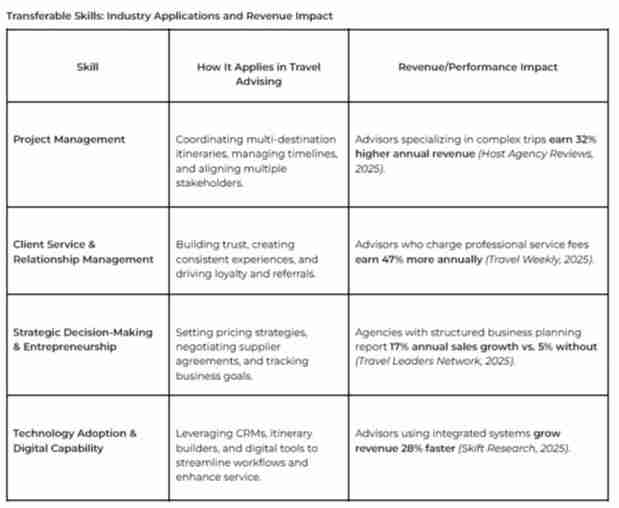
Professionals entering travel often underestimate how seamlessly their existing skills can apply. Here’s how key competencies translate into day-to-day success:
- Project Management – Coordinating multi-destination travel mirrors program management. It involves juggling timelines, adapting to shifting inputs, and satisfying multiple stakeholder needs. Industry Stat: Advisors who specialize in complex, multi-stop itineraries report an average 32% higher annual revenue compared to those who focus solely on simple bookings (Host Agency Reviews, 2025).
- Client Service and Relationship Management – Advisors succeed when they build trust, communicate clearly, and solve problems with grace. Professionals from education, healthcare, hospitality, and customer service often carry these skills into the travel space with ease. Industry Stat: More than half of U.S. advisors now charge professional service fees, and those who do earn on average 47% more annually than advisors who do not (Travel Weekly, 2025).
- Strategic Decision-Making and Entrepreneurship – Operating a travel business calls for delivering value, negotiating with suppliers, designing workfl ows, and managing risk. These skills are often strongest among former executives, business owners, and consultants. Industry Stat: Agencies that implemented structured planning and goal tracking reported 17% year-over-year sales growth, compared to just 5% for those without a plan (Travel Leaders Network, 2025).
- Technology Adoption and Digital Capability – Success in running a modern travel business depends on fluency with technology. CRMs, itinerary builders, payment platforms, and communication tools all enhance efficiency and client experience. Industry Stat: Advisors who adopt integrated systems grow revenue 28% faster than those who rely on manual processes (Skift Research, 2025).
V. Business Model Landscape
Understanding the available business models is essential for choosing the right fit. Each option offers a different balance of support, independence, and complexity.
- Host agencies – For many advisors, this is the most practical entry point. Hosts provide foundational support such as industry credentials, supplier relationships, marketing tools, and back-office systems that would otherwise be expensive or time-consuming to secure. New advisors benefit from structured mentorship, while experienced advisors appreciate higher commission splits and access to preferred supplier perks. According to Host Agency Reviews (2025), 93% of new advisors start with a host. This model is ideal if you want independence but don’t want to reinvent the wheel.
- Franchises – A franchise offers name recognition and a turnkey model that reduces the uncertainty of starting out. You gain established branding, processes, and sometimes even a dedicated territory. The tradeoff is cost and flexibility, since franchises often require upfront fees, ongoing royalties, and limited freedom to shape your own brand. Advisors who choose this model tend to value structure and a built-in marketing presence more than creative control. It works best if you want the backing of a recognized name, but consider whether the restrictions will still feel right in a few years.
- Sub-agent roles – Working as a sub-agent under an experienced advisor can be a smart way to learn with minimal upfront risk. You’ll likely receive guidance on client management, booking systems, and supplier relationships. The downside is limited autonomy, lower commission rates, and little opportunity to build your own brand. It’s similar to riding with training wheels; helpful for gaining balance, but not a long-term solution. Many advisors start here briefly before moving to a host agency or independent model.
- W-2 positions – These roles are typically found within larger agencies, supplier companies, consortia, or corporate travel departments. They provide predictable paychecks, benefits, and clear responsibilities. The tradeoff is flexibility. You’ll have less say over your client base, working hours, and overall direction. For some, it’s the right fit. Others may prefer entrepreneurship over employment.
- Independent operators – This model is best for seasoned entrepreneurs who want complete control. As an independent agency owner, you manage supplier contracts, licensing, marketing, client acquisition, and back-office systems. The upside is full autonomy and 100% of the revenue. The downside is greater complexity and full responsibility (Antravia Advisory, 2025). You must handle legal requirements, obtain E&O insurance, and build supplier relationships from scratch. Advisors who succeed here typically bring years of experience, strong business acumen, and a willingness to manage every aspect of the business.
VI. Solutions: Best Practices for Building a Profitable Travel Business
- Clarity of Process – Establish a defined client workflow that runs from initial inquiry to post-trip follow-up. A clear process increases efficiency and professionalism, ensuring consistent results.
- Repeatable Client Experience – Use templates for proposals, confirmations, follow-ups, and surveys. Consistency builds trust and encourages repeat business.
- Ongoing Accountability and Growth – Join peer groups, invest in continuing education, and track your goals consistently. Advisors engaged in mentorship programs report stronger retention and revenue growth (Travel Leaders Network, 2025).
- Legal and Foundational Essentials – Register your business, obtain insurance, and confirm compliance with all requirements. E&O coverage and proper licensing create credibility and protection for long-term stability (U.S. Travel Association, 2025).
VII. Case Studies
Together, these advisors have invoiced more than $5.5 million in gross sales since launching their businesses. Their stories show how transferable skills from careers as diverse as dentistry, software engineering, marketing, and real estate can be successfully applied in travel. While each advisor’s path has been different, the common thread is clear: with a defi ned niche, professional discipline, and the right support, prior experience can accelerate success in building a profitable travel business.
Robert Gordon – A former dentist, Robert launched his travel business in late 2022 with a focus on luxury. Since then, he’s invoiced over $2.25 million in sales, including nearly $1 million in the first half of 2025. His growth shows how service-based skills can drive success, even as he works to balance business demands with personal time. Lesson learned: Confidence grows with experience. Once Robert refined his client communication, referrals began flowing steadily.
Allison Amini – Allison, a former software engineer and published novelist, began her travel business in 2022. She’s now invoiced over $1.4 million, shifting her focus from cruises and literary travel to custom itineraries centered on cultural immersion. Her adaptability and community support have been key to her success. Lesson learned: Flexibility pays off. Allison found her niche by following client demand rather than sticking to her original plan.
Tracy Weed – With a background in marketing and informal experience planning group trips, Tracy officially launched her agency in 2024. She’s surpassed $1 million in gross sales, specializing in groups of 15–25 travelers. Tracy demonstrates how past experience can be transformed into a thriving business with professional systems in place. Lesson learned: Past experience counts. Tracy scaled quickly by formalizing her skills with the right structure and support.
Ana White – Ana, a former teacher and real estate agent, entered the industry in 2021. She’s invoiced more than $624,000, focusing on luxury travel and five-star experiences. By setting clear expectations and sticking to her service fees, she’s built a strong reputation for concierge-level service. Lesson learned: Boundaries build credibility. Ana grew by focusing on clients who value high-touch, luxury travel.
Takeaway: No matter your professional background, the same principles apply: clarity of focus, adaptability, and a commitment to professional standards are what turn transferable skills into lasting success.
VIII. Next Steps & Conclusion
You don’t have to start from scratch to succeed in the travel industry. What you need is alignment between your existing skills and the opportunities this profession provides. The strongest advisors are the ones who combine relationship-building, strategic thinking, and continuous learning with consistent action.
To put this into practice:
- Audit your skills – Write down the strengths you’ve gained in your current or past career, and note how they apply to client service, planning, or business operations.
- Match your model – Select a business model that supports your goals, whether that means the backing of a host agency, the structure of a franchise, or the independence of running your own agency.
- Build simple systems early – Use basic tools for client intake, tracking leads, and managing bookings. Processes don’t need to be complicated to be effective.
- Commit to ongoing education – Schedule time each month for supplier updates, business coaching, or peer learning. Staying current keeps your business sharp.
- Invest in relationships – Prioritize communication with clients and suppliers. Strong connections often lead to repeat business, referrals, and better opportunities.
Your next career move is closer than you think. Start small, take consistent steps, and surround yourself with the right support. The combination of your transferable skills and a clear strategy can turn your interest in travel into a profitable, sustainable business.
IX. References
- Antravia Advisory. (2025). Travel Agent Finance Guide 2025: Host agency vs. Independent. https://antravia.com/travel-agent-fi nance-guide-2025-host-agency-vs-independent
- Host Agency Reviews. (2025). Hosted Travel Advisor Report 2025. https://hostagencyreviews.com/blog/hosted-travel-advisor-report-2025
- IBISWorld. (2025). Travel Agencies in the US: Market Size Statistics. https://www.ibisworld.com/united-states/market-size/travel-agencies/1481/
- Phocuswright. (2025). U.S. Travel Agency Market: A Resilient and Thriving Segment. https://www.phocuswright.com/Travel-Research/Research-Updates/2025/us-travel-agency-market-a-resilient-and-thriving-segment
- Skift Research. (2025). The State of Travel Advisor Technology Adoption. https://research.skift.com
- Travel Leaders Network. (2025, February). Travel Advisor Prosperity Continues. https://www.travelweekly.com/Travel-News/Travel-Agent-Issues/Travel-Leaders-Network-2025-event-NYC
- Travel Weekly. (2025, August 3). More Than Half of US Advisors Now Charge fees. https://www.travelweekly.com/Travel-News/Travel-Agent-Issues/More-than-half-of-US-advisors-now-charge-fees
- U.S. Travel Association. (2025, January 9). Travel Forecast Winter 2025. https://www.ustravel.org/research/travel-forecasts