

Anthony Drago Nizetich, CTC
My organization’s travel policy was last written (or updated, I’m not sure) at least ten years or more ago; long before online booking tools, premium cabins, the sharing economy and smart phones; accompanied by the plethora of apps we have today at our fingertips. As such, our travel policy is in dire need of a modern update.
Two years ago, I ambitiously committed to update our travel policy as part of my annual Accountability and Talent Improvement plan; which is my organization’s employee goal setting and development program. And there it sat, gathering digital dust, maintaining its pitiful position for its second now consecutive year.
One would think that this is a sign of a chronic procrastinator or unmotivated employee, and there would undoubtedly be a fraction of truth to that. However, over those two years, I have been fielding travellers’ questions, observations and feedback on our current travel policy. The benefit of this two-year deferral, though, has allowed me time to note and record what our travel policy lacks and requires in this modern age of corporate travel.
Don’t consider that two-year hiatus as a complete loss – consider it an unplanned research opportunity and one of great consequence and benefit.
Naturally, there was an opportunity cost to not having drafted and released even an updated basic policy in the first year. After all, travel policies don’t have to be static and set in stone. Instead, they should be evolving and living documents. (MacNair Travel Management, 2018)
Nevertheless, this interval has allowed me to create a more thorough, practical and relevant travel policy.
This paper will provide advice on how to make the most of the time between committing to update or create a travel policy and then actually doing it.
Review Your Current Policy
Procrastination can pay off by helping you identify gaps in your current policy. In my case, each time a traveller, supplier or manager asked a question, I noted the topic and outcome and filed it away for inclusion in the policy. Some of these question included:
-
- Use of New Technology; such as Uber and Airbnb, bidding for upgrades with payment or frequent flyer points, mobile apps, supplier bots, etc. Consider whether your OBT’s use of Artificial Intelligence (AI) affects your traveller’s ability to adhere to travel policy.
- New Product Offerings: Newly sprouted hotels, airlines and routes, such as premium economy cabins, ancillary products like ancillary preferred economy seating, a new public airport express bus service, etc. The introduction of a new low cost carrier may entice travellers away from existing preferred airlines. It pays here to keep abreast of industry news and launches to anticipate new traveller needs and inquires.
- Inclusion of New Contracts: Be sure to review your policy whenever you contract with a new airline or supplier. Will this new contract impact your preferred airlines or create traveller confusion? Does your OBT policy need to be updated as a result?
- Benefits: Granted, frequent flyer programs have been around for many years, but more than a few travellers enquired whether frequent flyer points belonged to the organization or the traveller. It was understood that they belonged to the traveller, but it wasn’t made clear in the current policy.
- Health & Safety: After a polio epidemic in one of our travellers’ frequently visited countries, we realised that we needed to plan for and prepare to respond to epidemics and pandemics, by selecting recommended local travel doctors to provide our travellers with travel medical advice and immunisations, if required. Consider your organisation’s health insurance plan. Perhaps you can capitalise on that for corporate travel related advice, immunisations and support.
- Travel/Medical Insurance: Do your travellers know what to do in the case of a weather or medical emergency or a terrorist incident? If your organisation provides medical or travel insurance, ensure that travellers have and carry a medical insurance card providing emergency phone numbers and policy numbers. Countries that provide a public health care system may provide coverage of medical-related services provided in the home country, regardless of whether the injury was sustained overseas or in the home country.
I paid particular attention when more than one person asked the same or a similar question. These frequently asked questions are invaluable in creating a relevant travel policy. One such example was how to advise the availability of and provide booking instructions for smaller local or regional airlines that were not in our OBT because they were not in the GDS. This ignited a series of discussions with my TMC which ultimately identified opportunities to use new technology to interface the airline’s web-based system with our OBT. There were still airlines where the technology would now work, so “OBT booking exceptions” were required to be noted in the policy to allow travellers to book direct with these carriers.
If you haven’t benefited from such procrastinated feedback and questions, you may consider surveying your travellers to identify gaps that need filling in your policy. Speaking to your travellers will help you understand how business travel impacts on their business and their personal lives, which is crucial when deciding what travellers should be entitled to. (Flight Centre Business Travel, 2019)
Ask stakeholders, suppliers, account managers and your TMC’s agents how your policy impacts them, and find out what questions your travellers are asking them. Consider calling a one-off traveller meeting followed by an anonymous online survey to allow your travellers to provide shameless feedback. Ask what they have always been too embarrassed to ask. Allow them to question the current policy! These exercises may reveal undetected gaps and opportunities to create a more comprehensive travel policy.
In addition to the questions I fielded during my procrastination process, ensure that your policy includes at least the following most basic instructions:
-
- Where your employees can book travel
- How the approval process works
- How to pay for their travel
- How to claim their expenses, and what is refundable and what isn’t
- Flights, hotels and ground transport guidelines – what they can and can’t do
- How to use any travel apps or booking tools
(Flight Centre Business Travel, 2019)
Lastly, we didn’t have an online booking tool (OBT) when our policy was last prepared, so it was time to set new goals around online/offline bookings, advanced ticketing, preferred airline market share targets and so forth. (Sheffield, 2016)
Align with HQ Policies
My organisation is a global non-profit church headquartered in the United States. Twelve area administration offices serve congregations, volunteers and employees located in each geographic area. I am responsible for employee and volunteer travellers in the Pacific Area; which includes Australia, New Zealand and nearly all of the Pacific islands. Each “area” has a degree of flexibility to adapt to local conditions.
In considering and reviewing travel policy, be sure to align your policy with your organization’s headquarters or main office to avoid conflicting policies and confusion. This could discredit all or portions of your travel policy.
Be sure to counsel with a counterpart at your main office before finalising and distributing your revised travel policy, if you are located in a satellite office or area. Determine which polices are required to be consistent with HQ and which can be adjusted to local conditions.
For instance, our HQ travellers mostly fly on short domestic flights in the US, where premium economy seats are nominally more expensive than regular economy seats. In the Pacific, most travel is of longer duration and local carriers offer a very different premium economy product at a significantly higher price. In this case, local product and cost differences were not apples-to-apples and therefore resulted in different premium economy policies.
In the modern global environment, it is important to make sure that your travel policies account for local conditions, but still remain consistent with the spirit – if not the letter – of your main office’s policy.
Today’s Traveller Needs and Tools
The sharing economy has provided us with amazing technology and tools that many of our travellers are quite eager to use, and there is no better time than a policy review to consider these new products such as Uber, Airbnb and any other new services available in your market.
Jenna Sheffield of 30 Seconds to Fly suggests that you “let travellers know where you stand on the issue” of the likes of Uber and Airbnb. (Sheffield, 2016) For example, some companies do not allow travellers to book with Airbnb, because “the company has duty of care obligations, and as a travel manager, I don’t know if the Airbnb house, apartment, or other is safe for our employees.” (Wolko, 2015)
Bleisure, or the addition of extra days to a business trip for leisure, has generally been approved in my organization by managers on a case-by-case basis. This was fine, but as word spread, it became clear that we needed some clear consistency about how we manage such requests due to the level of perception and ensuring that there were no cases of intentional or unintentional fraud – or even the perception of such. This was exceptionally important as a non-profit organisation.
There are, however, possibly benefits to allowing bleisure in your policy. For example, “you can save the company money by tacking on a day or two of personal travel on a business trip,” (Wolko, 2015) “such as when a flight costs less if you’re traveling on a less busy day. Your company might consider allowing personal time so long as it saves the company money or it is clear when the company’s coverage of costs ends and the traveller’s begins.” (Sheffield, 2016)
It’s All in the Delivery
Ensure that you define your travel policy’s objective and outline it in the first section of the policy document. Your objective should align with your organization’s culture and purpose. In addition, objectives could be keeping costs down to maximize the traveller’s travel budget; helping them make decisions on their travel; and ensuring that employees are productive, safe and comfortable while traveling.
Also consider the current format and language. There aren’t many who want to read a 20 page document that’s written like a legal contract. Now may be the time to rewrite it in simple English with clear details. (Flight Centre Business Travel, 2019)
MacNair Travel Management encourages “pulling in the right representatives from all applicable departments – legal, HR, finance, procurement and senior management – [to] increase their engagement in and awareness of the policy. This gives them a stake in the policy and makes compliance more likely. Pulling in senior management will facilitate support and buy in for your travel policy.” (MacNair Travel Management, 2018)
“Once you have your policy updated and have buy-in from senior management, having a focus on communicating these procedures to your employees should improve your results.” (MacNair Travel Management, 2018) This is easily the number one behaviour-changing strategy. (Adams, 2017)
Tony Schwartz writes for Harvard Business Review that an updated policy is not enough to drive behavioural change. We must also be mindful of what people think and feel – what rolls up into their mind-set – when we introduce our updated policy. Schwartz argues that “the invisible fears and insecurities that keep us locked into behaviours even when we know rationally that they don’t serve us well” can be overcome by tackling anxiety, “confirmation bias” (seeking only evidence that supports what we already believe) and risk avoidance. “All of this explains why the most effective transformation begins with what’s going on inside people – and especially the most senior leaders” of your organization. Leaders have an outsized impact on the collective mind-set… and even employees highly resistant to change tend to follow their leaders.” Letting your travellers know that your policy is delivered with senior management’s backing is imperative. (Schwartz, 2018)
According to an ACTE survey, 80% of travel managers use more sophisticated tactics to persuade travellers and drive policy compliance. These tactics do not need to be very elaborate, but they’re effective, because they speak to the traveller’s conscious. For instance, travellers could respond to guilt if they see how much gold-star employees are saving by making in-policy bookings vs. those who aren’t. Some companies also implement incentive programs that reward employees for following the company travel policy (Eduardo Alonso, 2018) though you may find these difficult to withdraw when circumstances and business needs change.
In addition to the support of your senior management, consider a single-page graphic representation of key policy points in addition to your written policy. The FCM policy page below provides an example:
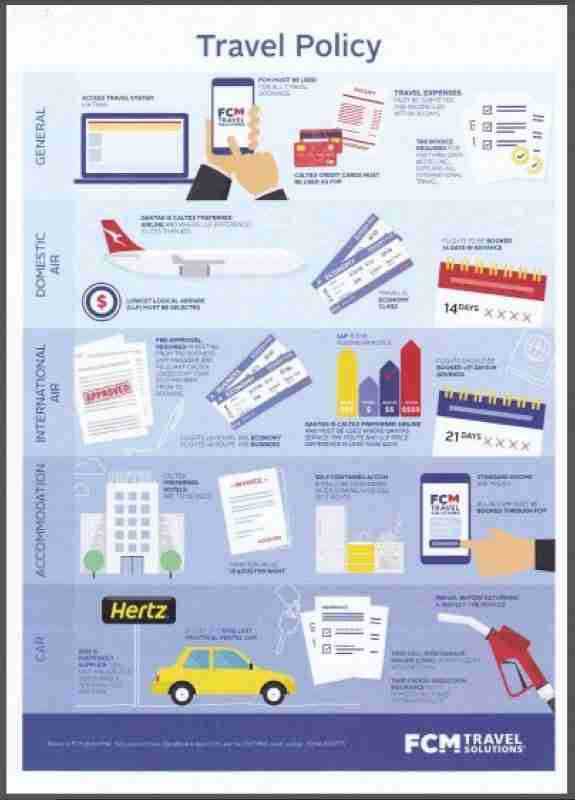
(FCM Travel Solutions, 2018)
An Egencia survey found that business travellers prefer to find policy information on the company intranet, booking tool, or from a travel arranger – as opposed to through email. Set up the policies in your online and mobile booking tool and make sure that travel arrangers have this information easily accessible (Sheffield, 2016) and compatible across all travel booking and management devices and platforms. (Corporate Meetings Network, 2017)
Summary
As a travel manager, you thrive on thinking about and booking travel.
However, your finance or real estate manager probably doesn’t – and some may be downright resentful for having to travel. Don’t assume that your travellers want to spend much time booking their trips – your job is to make travel as simple, clear, quick and seamless as possible. Travellers do want to do the right thing while traveling, so don’t leave them guessing about what is and isn’t within policy.
And, if you have been procrastinating updating your travel policy, make the most of it. Consider the time “research” and listen to your travellers so you can craft a clear and concise travel policy.
Once you have an updated policy, you’re not done yet. Your travel policy is a living document – review it on a regular basis to keep it up to date and relevant. Travellers have more options and information than ever, so keep on top of industry developments and incorporate them into your policy to better meet travellers’ needs. Keep your finger on the pulse of your organisation and the needs of your travellers to nimbly evolve policy to fulfil your duty of care and maximise traveller comforts and budgets.
Business travel doesn’t happen in a vacuum. It’s a partnership. So make sure to keep communication lines open between your TMC and the traveller. This can achieve greater clarity for all parties, which ultimately saves the business money. (Champagne, 2016)
Happy safe travelling!
Works Cited
Adams, J. (2017, May 24). Why do travellers fail to comply with travel policy… And how can your TMC help? Retrieved from Amadeus Africa Blog: https://amadeusafricablog.com/travellers-fail-comply-travel-policy-can-tmc-help/
Champagne, E. (2016, December 6). Tips for TMCs to prevent travel policy leakage in the self-booking era. Retrieved April 25, 2018, from Sabre.com: https://www.sabre.com/insights/tips-for-tmcs-to-prevent-travel-policy-leakage-in-the-self-booking-era/
Corporate Meetings Network. (2017, July 11). Business Travellers expect to manage travel on all devices. Retrieved from Corporate Meetings Network: https://www.corporatemeetingsnetwork.ca/2017/07/11/business-travellers-expect-manage-travel-devices/
Eduardo Alonso. (2018, February 6). Three Strategies to Promote Travel Policy Compliance. Retrieved April 25, 2018, from Hotelzon.com: https://www.hotelzon.com/2018/02/three-strategies-promote-travel-policy-compliance/
FCM Travel Solutions. (2018). Sample Travel Policy Graphic. Based on FCM global MNC data sourced from ClientBank in April 2018 and the 2017 MNC client survey. FCMAUS80775. FCM Travel Solutions.
Flight Centre Business Travel. (2019, May 11). Flight Centre Business Travel. Retrieved from Flight Centre: https://flightcentrebusinesstravel.co.uk/white-papers/writing-your-company-travel-policy
MacNair Travel Management. (2018, November 25). 4 Tactics for Reviewing and Updating Your Travel Policy. Retrieved from http://www.macnairtravel.com/4-tactics-for-reviewing-and-updating-your-travel-policy
Schwartz, T. (2018). Leaders Focus Too Much on Changing Policies, and Not Enough on Changing Minds. Harvard Business Review.
Sheffield, J. (2016, September 15). How to Write a Travel Policy. Retrieved November 25, 2018, from 30 Seconds to Fly: https://www.30secondstofly.com/corporate-travel-management/how-to-write-a-travel-policy/
Wolko, S. (2015, August 13). 10 Reasons why Airbnb for Business Travel Isn’t Good. Retrieved May 19, 2019, from PhilaTravelGirl.com: http://philatravelgirl.com/airbnb_business_travelers/