

R. Lynn MacIlvain-Fehrle, CTC
One of the fastest growing professions talked about globally is Project Management. It is projected that by the year 2020 15.7 million roles will be created globally with growth in the United States alone, behind China and India, estimated at 2,348,830. Managing projects is not a career most individuals set out to establish but it is one that on many occasions fall into their laps and assigned many titles.
The titles and roles amongst companies, regardless of size, will vary but a few that are commonly used are Project Manager, Project Lead, Product Owner, Program Manager, Team Leader and Team Assistant. Some companies even become creative and give titles such as Project Meanie. Regardless of the title, most people don’t realize that projects have been undertaken for thousands of years · the ancient Egyptian pyramids · the planning and military strategy of Tzu Sun · the Roman Colosseum · the beautiful cathedrals of Europe and settlements throughout the world. Back in the times, these individuals had titles such as Grand Seneschal, Grand Marshall, Priest, Stone Master, or Curator.
Regardless of the many titles developed over the centuries what hasn’t changed is the definition of a project. Per the Project Management Institute, the global definition reads: a project is temporary in that is has a defined beginning and end in time, and therefore defined scope and resources. And a project is unique in that it is not a routine operation, but a specific set of operations designed to accomplish a singular goal. Project Management, then, is the application of knowledge, skills, tools, and techniques to project activities to meet the project requirement.
Why present the argument a home-based agent is their own project manager?
When transitioning my career from a Financial and Project Manager in the travel industry to a home-based agent I found myself incorporating project managing skills into my mini projects now called vacations. For every new vacation itinerary being developed the five phases of project management applied: Initiation, Planning, Executing, Monitoring, Controlling and Closing. Regardless of the itinerary size, a group or individual, the same constraints associated with a large project also applied to a small project: managing time, managing cost, managing efficiencies, identifying potential risks, administering procurements, and communicating to stakeholders. From initiating the first contact from a customer lead to finalizing the trip with a thank you note, I was managing my own projects.
Initiation Stage
The Initiation Stage is the beginning of a project where it is explored to determine why the project is needed and is it feasible? Who will be involved? What will the results be? Will it increase efficiencies, increase revenue, increase customer satisfaction? This stage is the most critical part of a project as it identifies the strategy to be used to accomplish the end results. 65% of projects fail because of initiation problems due to no strategy followed, lack of experience, or lack of management support.
In the travel industry projects continuously arise whether it be a new marketing plan to increase a customer base, working with suppliers to have them improve their reporting tools for the agency or agent, researching and recommending a new booking tool platform to increase efficiencies and sales, or organizing a yearly world cruise group.
If employed by an agency, hopefully, there will be support of a manager or owner to help with this stage. However, if a home-based agent which is approximately 44% of the ASTA member agents today, the Initiation Stage is your responsibility to develop and plan should it be feasible.
Planning Stage
The moment it is determined from a customer the why, who, what, when, and how in a project the Planning Stage can begin. This stage, also critical to a project, involves developing a plan to manage time, costs, travel suppliers, network contacts, procurements, how and when to communicate to a customer and the risks involved for last-minute developments.
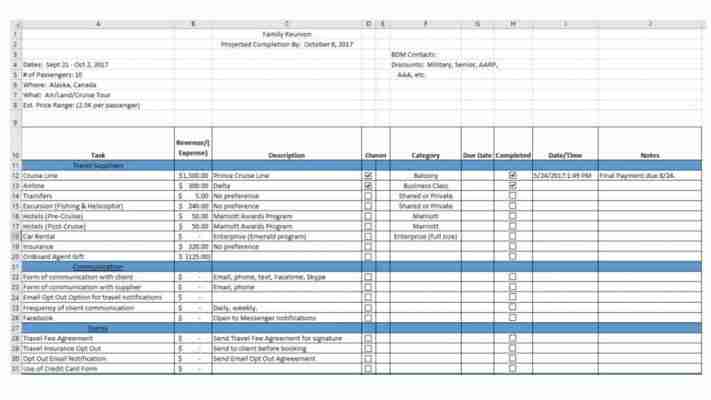
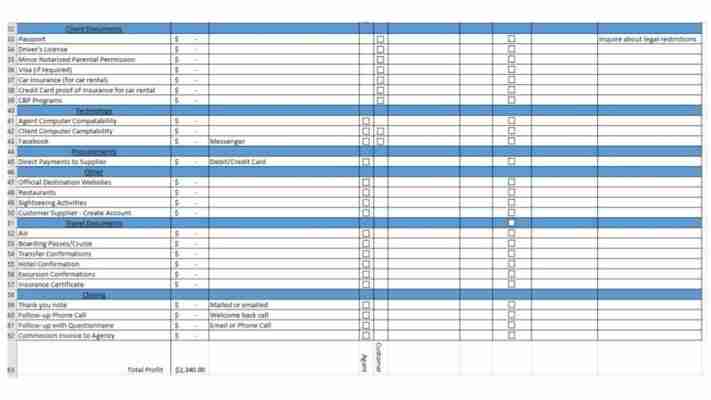
When it comes to planning, most agents have several projects occurring at the same time. Some are more time consuming than others, particularly groups, but how it is managed from the beginning to end will determine its success. If an agency or host agency has a project management module incorporated into a CRM (Customer Relationship Management) system to assist in planning and tracking, it can be utilized. For those that don’t, a project planning template can be developed in Excel. Below is a template I’ve developed for myself for every trip, small or large. It is a working document that is continuously updated and used as a starting point.
Planning is like brainstorming and no two projects are the same. It is identifying, gathering, and scheduling every imaginable task that needs to occur and projecting risks that could occur over the course of the project before moving on to the Execution Stage.
Travel Project Template Example
Execution Stage
The Execution Stage is the most time consuming of a project as it is when the physical deliverables are developed and presented to a client. It is the longest of the project management phases because it consumes the most time and energy.
Being that the discussion here is about travel agents being their own project manager, the deliverables discussed are travel related with the most important being sales proposals, booking itineraries, travel documents, and delivery of supplier products.
During the Execution Stage, the sales proposal can be the most time consuming as it requires not only research to find quality products to meet a client’s budget but also preparing a quality presentation for the client. The time constraints associated with researching, establishing client relationships, establishing supplier contacts and relationships, identifying risks to manage or avoid, and anticipating customer questions regarding the suppliers and price are time-consuming. Managing the sales proposal, especially in today’s world where everyone wants an estimate within hours, should be carefully thought out and executed to avoid a complete redo. This is also when all the client’s information regarding travel dates, names, birth dates, parent custody papers, etc. that are either on a license or passport are confirmed to move towards booking the itinerary.
The next time-consuming deliverable is coordinating and booking the itinerary. Some itineraries are quick and easy to book. However, for FIT bookings it takes time to coordinate all the trip segments when a tour package is not an option. Some time constraints and risks to take into consideration while booking are: Customer reviewing and confirming personal information prior to booking; Personal computer software compatibility; Agent being unfamiliar with how to book with a supplier; Supplier accepts only phone call or email reservations; Availability of activities at destinations because not all museums, restaurants, day excursions, or transportation are available seven days a week; And, the risk of a client changing their dates at the last minute before or even during booking. Taking these constraints and risks into consideration can allow one to project an estimated completion date of booking the itinerary and presenting the travel confirmation documents to a client.
The third deliverable mentioned, travel documents, are provided to clients several times throughout the life of a project. Preparing, reviewing, and sending the travel documents may not be as time-consuming as the beginning stages of a project but it requires an aptitude for detail and efficiencies. Every itinerary differs and time should be allotted to make sure the document information is correct. It means identifying the method of delivery, making sure the documents are sent to the correct address and client, confirming the delivery of the documents and arranging a pre-departure meeting with the client to review the documents and answer any questions or concern. The execution of the documents should be well thought out and planned to avoid risks associated with possible delivery delays or client changes before the delivery of the final product, the trip itself.
Finally, executing the delivery of the supplier to a customer – the final step of the Execution Stage when the customer departs on the trip. It may be the least time consuming of all stages but risks associated with delays, supplier overbookings, or client dissatisfaction at the destination need to be addressed. A smooth departure, arrival, and return is always the objective but risks do happen. Factoring in some extra time over the travel period to address the risks will result in efficiencies for future or other current projects in progress.
Monitoring and Control Stage
The fourth phase of a project, Monitoring and Controlling, technically starts at the Execution Stage and continues until the closing date. From the time a sales proposal is submitted until a client returns from a trip, the project is continuously being managed, reviewed, updated or even revised. Whether it be booking deadlines, customer payments, commission payments, destination researches, communications between clients and suppliers, change requests by clients, upsells to increase revenue, possible renegotiations for a group, managing outsourced tasks, reviewing itineraries, or tracking the delivery of documents, it requires monitoring and controlling. It is a necessity. Being consciously aware of a project’s progress enables you to recognize problems and take corrective action at the appropriate time before it becomes unsolvable. Just knowing when actual results diverge from a plan allows corrective action to take place at the appropriate time.
Closing Stage
During the 1973 National Baseball season pennant race, Yogi Berra, a former Major League Baseball catcher, utter the phrase “It ain’t over til it’s over.” And as the saying goes, the same applies to closing a project. Especially for travel agents.
Many project managers consider a project closed with the final delivery of the product and getting the sign-off acceptance from the customer. They think it burdensome to formally close out the project as it fizzles away and have other projects on their agenda to start. Per the Project Management Institute, the Closing Stage is as impactful and significant as the Initiation, Planning, Executing and Monitoring and Controlling stages. Managers should meet with their teams to determine what did and didn’t go well and have an open discussion about improvements for future projects. It is a time to make sure all payments to vendors have been paid, make sure contracts are closed, self-evaluate your performance as a manager or home-based agent and archive records. Why is it so important? The information gathered can be used as input for future projects to improve efficiencies and prevent reinventing the wheel.
For travel agents, projects are longer and extend well past the date the supplier is delivered to the client because we continuously monitor and control an itinerary until the client returns home. Many of the closing responsibilities that can help with future projects can be performed during the vacation period. However, travel agents still need to follow-up with a client with a thank you note, client phone call or questionnaire about the trip and destination and track commissions well past the final delivery of the product. And, as most agents know, commission payments are not received instantaneously. “It ain’t over til it’s over” which is when a client returns, a client is happy, and revenue is received.
Home-Based Travel Agents You Are Your Own Project Manager
Project Managers have existed for thousands of years with titles developing as the centuries pass. Many professionals don’t realize they’re performing project management skills during temporary assignments due to unavailable educational resources or training from management.
Before switching to a travel career I managed many projects in various industries but never took the opportunity to educate myself further about project management to enhance my skills. It wasn’t until I initiated a project with one of the largest GDS companies to develop and improve their cruise reporting for agents to track passengers, commissions, groups, sail dates, and agency segment revenue that I decided to enroll in classes. Through Ed2Go which partners with many colleges, universities and corporations I completed two courses accredited by the Project Management Institute – Fundamentals of Project Management and Business Analysis. Immediately I found myself using the new project skills not only for management but for the agents by developing templates for them to use to manage their mini projects, vacations. When I became an agent myself, the skills kicked in immediately to help manage and control my own customer’s itineraries.
If you’re an agency owner or agent, whether store-front or home-based, review the project template example provided. Look at all the tasks and deliverables associated with just one trip itinerary and I’m sure you’ll want to add responsibilities. What you’ll start realizing is that you’re not only a travel professional, you’re also your own project manager who executes and delivers products that make many people in the world happy – vacations.
Works Cited
Aziz, E. E. (2015). Project closing: the small process group with big impact. Paper presented at PMI® Global Congress 2015—EMEA, London, England. Newtown Square, PA: Project Management Institute. Retrieve May 22, 2017 from the World Wide Web: http://www.pmi.org/learning/library/importance-of-closing-process-group-9949
Biesiada, Jamie. (2016, November 17). 44% of ASTA members are home-based agencies. Retrieved May 1, 2017 Retrieved from the World Wide Web:
http://www.travelweekly.com/Travel-News/Travel-Agent-Issues/44-of-ASTA-members-are-home-based-agencies
Campbell, Clark A. and Mark Campbell. The New One-Page Project Manager. John Wiley & Sons, Inc., 2013
Linkner, Josh. (2014, December 4). The 21 Most Creative Job Titles, Forbes, Retrieved May 21, 2017 from the World Wide Web:
https://www.forbes.com/sites/joshlinkner/2014/12/04/the-21-most-creative-job-titles/#3804977f2933
McConnell, Eric. (2010, July). Managing Project Initiation Phase – A List of Critical Problems & Suggestions. Retrieved May 19, 2017 from the World Wide Web: http://www.mymanagementguide.com/managing-project-initiation-phase-a-list-of-the-most-frequent-project-initiation-problems/
15 Shocking Project Management Statistics |Project Journal (2016, March 30). General Project Management. #PM Chat. Retrieved May 5, from the World Wide Web. http://pmchat.net/2016/03/30/15-shocking-project-management-statistics-project-journal/
What is Project Management? Project Management Institution. Retrieved April 30, 2017 from World Wide Web:
https://www.pmi.org/about/learn-about-pmi/what-is-project-management
Ed2Go. Project Management Fundamentals.
https://www.ed2go.com/online-courses/project-management-fundamentals