

Trish Gastineau, CTIE, MCC
INTRODUCTION
I was recently taken aback by a quote I read. It was reported in the May 7, 2018 Travel Institute report, “The Changing Face of Travel Agents.” It stated, “Although all ICs [Independent Contractors] are technically “business owners,” the majority (57%) identify themselves as travel agent “counselors” or “consultants” rather than “business owner.”
Unfortunately, this kind of thinking is naïve on the IC’s part and can leave these budding entrepreneurs and their travel businesses exposed to legal and financial pitfalls that can irreparably harm them.
Because there are more Independent Contractors in the Travel Industry than ever before (i), it is imperative to promote an entrepreneurial mindset to build profitable business models that have a better chance to endure.
PRODUCT/SERVICE/METHODOLOGY
I chose this topic for my White Paper after doing an online search for information on Independent Contractors in the travel industry. I came across a report in Travel Agent Central’s May 7, 2018 issue on the subject from The Travel Institute. I have been in the travel industry since 1993 and realized that in recent years, most advisors new to the industry whom I was meeting, were choosing the IC route due to the autonomy. The freedom to choose with whom, when, and even where to work, without having to clear travel plans with a boss, where the most voiced perks mentioned when I questioned them. There are certainly many more ICs than ever before; until I read the referenced article, I did not fully realize the proliferation of the Independent Contractors over the last ten years.
KEY FINDINGS
The low barrier to entry into the Travel Industry can set an IC up for failure.
The excitement of entering the Travel Industry can be heady! The allure of travel is glamorous and exotic. I can remember applying for my first agency job in 1993. I had the idea that I would be jet-setting around the globe and selling wonderful vacations to fabulous people! It did not dawn on me that my boss would expect me to sit at my desk, answer the phone, greet the in-person visitors, file brochures and faxes (ii), sell travel, and do a lot of very unglamorous paperwork.
Back then we were either “Inside Agents;” employees of a brick and mortar travel agency; or “Outside Agents;” the forerunner of today’s independent contractors. Unfortunately, Outside Agents were seen by many as being dabblers in the travel industry who were looking for free trips. They were characterized as hobbyist and often excluded from Educational (FAM Trips) opportunities and sometimes treated as inconveniences by the agencies with whom they worked. Boy, has the landscape in the industry changed since then!
The opportunity to sell travel while enjoying it yourself has always been a big draw to most people entering the industry! Travel is exciting, and it is one of the perks that I wish I could have enjoyed more of during my first 10 years as an employee. With today’s technology, being an Independent Contractor gives you the freedom to work untethered, allowing you to set up shop anywhere you can gain internet access. The truth remains; the low barrier of entry to the industry can set ICs up for failure.
Being a Travel Advisor today is much more akin to being a Real Estate Agent or Financial Planner. Unlike either of these professions, there is no organized training or licensing required (iii). As an industry we are no longer merely considered, “agents for the airline.” We have moved on from being “order takers” who primarily made airline ticket reservations or cruise bookings, to being advisors/consultants to our clients, exploring all aspects of travel, recommending both destinations and experiences. Because there is no professional licensing (iv) or training requirements, anyone can hang out a shingle and say, “Hey, starting today I’m a travel agent.”
Another tell-tell sign of this low barrier to entry is that to work with some travel vendors and partners, all you need to do is call them and set up an account. Some partners will work exclusively with industry advisors with access to credentials such as a CLIA, TRUE, or ARC numbers, but I have found that some are willing to set up new accounts if they are supplied with simply a phone number and an address.
It is not difficult, for an IC new to the Travel Industry, to find an existing Agency who will host them. (Many times, for a hefty commission split.) This host agency will then provide the IC with their agency’s booking credentials, allowing new reservations to be made right away. The challenge is that without meaning to, an untrained IC may be putting their client(s), and themselves, in jeopardy because, “they simply don’t know what they don’t know.”
Choose to run a profitable business and have fun or only have an expensive hobby.
While it is not sexy, ICs have a responsibility to be educated and do what they can to protect themselves and their clients. An IC should set themselves up for success by first adopting an entrepreneurial mindset, then following it up with the actions of a successful business owner. This significantly increases, but does not guarantee, the chances of having a profitable business. Because, if the Internal Revenue Service (IRS) investigates a “business” and decides that it is instead only a hobby, that business will lose the lovely tax deductions that they had been entitled to!
In staying with the entrepreneurial mindset, it makes sense for an IC to speak with an attorney or an accountant/CPA and find out the best way to set up a business entity to protect both their business and personal assets. These professionals will advise the business owner of their choices and will be able to guide them to the option that makes the most sense to their individual situation.
Among the options.
-
- Sole Proprietorship
- Limited Liability Company (LLC)
- Incorporation (INC).
While at this stage, have an attorney help draw up terms and conditions. This will set clear expectations between the business and their clients. In these Terms and Conditions (T&C), list the business’ responsibility, the client’s responsibility, and lay out that the business is not responsible for the actions of their partners or Acts of God. This document can save a lot of money and headaches down the road!
Next, find a good Errors and Omissions insurance policy. Errors and Omissions Insurance, also known as E&O, can help you personally, as well as your business, should you make a mistake while booking a client’s trip, or if a client decides to sue you. As an IC, I believe it is always best to have your own policy. If you are part of a host agency and they offer you coverage on their in- house policy, keep in mind that their one policy covers all their advisors and ICs. That means should you need to file a claim, the piece of the pie available to you, might be all but nonexistent if other claims have already been made.
Taking the time to learn the legalities of setting up a business will pay dividends down the road. It is not the sexy part of the travel business, but neither are paying fines, or paying an attorney out of pocket for a claim that would have been covered under a professional Errors and Omissions insurance policy if you were to get sued by a client for a trip gone wrong!
As an IC entering the travel industry, you are starting a small business. As such, there are local and state requirements to make a travel business legal. There can be hefty fines for noncompliance of ordinances, so make sure to educate yourself on any “Seller of Travel Laws” for your state, as well as any state your individual travelers reside in. Service fees, or Professional Management fees, can significantly add to an IC’s bottom line. Knowing how these “Seller of Travel Laws” affect an IC’s ability to collect fees, (either directly or through the services of a host agency,) will be important when outlining the IC’s business plan.
Once the local and or state business requirements are taken care of, a business entity has been chosen, and your E & O Insurance needs have been met, now work on your written business plan. This does not have to be complicated, and you can find free templates online, or even in word processing programs like WORD.
In the plan, outline the purpose of the Travel Business, what products it will represent and to whom it will be selling, future goals, financial or budgetary requirements, and maybe even who the competition is. Making a written Business Plan, even an informal one, will be a road map to success, and can always be updated as the business moves forward and gains a clearer picture of where they genuinely want to go. You could also add how many trips per year you would like to participate in!
When it comes to finances, set up a separate bank account for the travel business. It is never a good idea to mix personal money and travel business money. Having an account dedicated to only the travel business is another form of protection for an IC and their clients. A business checking is great, but even a personal account only used for the travel business will work. If possible, also have a separate credit card for business charges.
Another important, if not the most important, thing for your business is a way to keep track of the customer’s information. A Customer Relationship Management (CRM) system will be the business’ most prized possession. There are many available on the market, look for one that specializes in the travel industry and our unique challenges. Remember, the client database is going to be the bread and butter of the business so back it up! Keep this database updated and in a secure place, with strong passwords. If credit card information is collected, make sure that you are Payment Card Industry (PCI) compliant.
Your mother was correct when she told you to be careful who you associate with!
If you Google motivational speaker Mr. Jim Rohn, you will quickly find his famous saying, “you are the average of the five people you spend the most time with,” and I firmly believe that the Host Agency, Travel Partners, and clientele you do business with, will reflect on you; either in a positive or a negative light.
While it is easy to, “go it alone” in the travel industry, aligning with the right industry partners will go a long way toward success! The written business plan will outline to whom, as well as what, will be sold. While it may be tempting to offer mass-market travel products, keep in mind that there is already a lot of competition in that market, and it may be difficult to add extra value and stand out. Honesty there is not always a large profit margin selling mass-market, so it is important to earn the highest commission level possible from the start. By selling products that cannot be easily duplicated by the clients or competition, a travel business can better demonstrate their value proposition and stand out.
To demonstrate how the products that are sold can make a huge financial impact on a business, I have researched two few real-life options.
The first one is a mass market 3-night cruise to the Bahamas priced in the lowest inside stateroom category (v). The date is March 8, 2021 sailing from Miami. The total price for 2 passengers sharing a stateroom (cabin) is $840.58 based on a residency special for passengers who are from the state of Georgia. (I picked this state at random)
PLOT TWIST! Commission is not always earned on the on the total amount of the sale!
In our example we must subtract the port charges of $108.79 per person, and the cruise line’s “Non-Commissionable Fare” of $100 per person. As a result, we will earn our commission from the remaining $423.00.
Assuming a 10% base commission if booked directly with the cruise line, the earned commission is $42.30 TOTAL on this sale. By leveraging a host agency relationship, one might be able to earn as much as $67.68 due to the host’s booking volume. It is important to note that the passenger would pay the exact same amount either way.
Conversely, if booking a European River Cruise (vi) that is 3 nights, in the lowest priced stateroom (cabin) category for May 2, 2021 from Budapest, the total price for the stateroom is $2,616.00. (After a sales discount from the cruise line of $750.) After removing port charges and taxes totaling $84.00 per person, a commission would be earned on the net amount of $2,158.56.
Assuming a 10% base commission if booked directly with the cruise line, the earned commission is $215.80. By leveraging a host agency relationship, one might be able to earn as much as $457.44 due to the host’s booking volume.
Again, it is important to note that in each of these examples the passenger would pay the exact same amount. The only change is the percentage of commission earned on the reservation.
If we compared the 10% commission examples, one would have to sell 5.1 MORE staterooms on the mass market cruise from Miami, than the 3-night cruise from Budapest to earn the same money! It would be difficult to scale this as booking and managing 5 times the number of passengers is time consuming.
Another important factor to profitability in the travel industry, is the amount of commissions you will be able to earn on the products your business chooses to partner with, (sell).
As an IC you are a business owner and you can sell what you would like to whom you want. Thinking like an entrepreneur will have you ask yourself a lot of questions and considering things from other angles.
Some questions you might start with are:
-
- Which products do I have a passion for?
- Which travel partners have the best reputation for taking care of both my business and my clients?
- Which travel products will be most profitable for my business to sell?
- Which clientele can my business work with, who will have higher travel budgets, and who might travel more often?
Again, ask a lot of questions when you are looking at host agencies.
Which host agency can you join that will offer.
-
- A good reputation in the industry?
- Offer trainings that I may need?
- Offer a higher commission on the travel vender’s products that fit my business model?
- Have a commission sharing plan that will still be attractive in five years when the business is selling more travel?
Finding a host agency to partner with that can offer an IC up to 2 – 8 percent more commission than could be earned by booking directly is smart. There is not any good reason to leave that kind of money laying on the table.
A $5, 000 booking that earned a 10% commission is $500, but if you were able to earn a higher percentage, it will make a huge impact on your bottom line! Whenever possible, work smarter, not harder.
Selling $5,000 booking and earning

While the financial options are important, success is not measured solely by them. The human factor also bears a lot of weight. Finding a host agency that matches the ICs personality and style is important, and the way that ICs are treated is essential to their happiness!
If, as an IC you choose to work with a host agency, (and you should consider it) then the commission agreement is not the only thing to be considered! A host agency will be part of an ICs Success Team, along with their clients, and travel partners. Look for an agency that is focused on working with ICs and understands that unique business model.
A host agency is never your boss. Either the host agency or the IC can terminate the agreement when the relationship is no longer working. The host does not hire, nor do they fire. Instead, think of a host agency as a hired service. As an entrepreneur, you need to make sure to think about the IC/Host relationship in the proper way.
The IRS (vii) defines an Independent Contractor in this way; “The general rule is that an individual is an independent contractor if the payer has the right to control or direct only the result of the work and not what will be done and how it will be done. The earnings of a person who is working as an independent contractor are subject to Self-Employment Tax.”
Because an IC is not an employee, the host agency does not pay an earned wage, nor do they set hours that must be worked. The IC will be responsible for their own business needs such as business cards, computers, and internet access, as well as a place from which to work. Special care should be taken by both the IC and the host to maintain the boundaries set by the IRS, otherwise the IC could be considered by the IRS to be an employee, and that will open a whole new can of worms for both of them!
Remember, the host agency collects the commission on the travel products that an IC sells, and then passes the agreed upon commission split to the IC. The host agency is also the ones who maintain the relationship with the travel partners. The IC pays for the host’s services from the split of commission agreed upon, or by paying them a monthly fee for 100% of the commission earned.
Another important point is that a signed contact between the IC and Host Agency is needed that clearly states the services to be provided, either a monthly fee, a split of your future commission, or maybe a combination of both. This agreement should also clearly outline what happens to an ICs reservations/bookings and commissions should either decide to sever the working relationship. This should be in writing BEFORE any reservations are made using the host’s credentials. Think about this as if it were a marriage. We are all in love in the beginning, but if things go sour, it is much better that there is a written agreement in place, like a pre-nup, that will protect both parties.
I think of my wonderful host agency as a professional service that I have hired to help me be successful.
A good Host Agency offers several benefits:
-
- A single source of commission collection and distribution
- Access to Travel Suppliers and their Trainings
- Access to a Travel Consortium such as the Virtuoso Network, (if applicable)
- Connections to Like-Minded ICs.
If we are known by the average of the five people we spend the most time with, then these are the folks that I want to be around!
How do I know which choice to make?
It is better to make decisions based on where you want to be in five years, rather than where you are right now. I have a couple of steadfast rules of thumb that have helped me in my business over the years. One is to always buy technology with the fastest computing speeds and the most memory that I can afford because technology changes so quickly. The other rule of thumb that has never disappointed me is to make my decisions based on where I want my business to be in five years. I find this one especially important because when changing from one host agency to another, an IC may find that they will leave money on the table.
An IC who knows they want to sell to a luxury product to an affluent clientele, realizes they can earn larger commissions quickly. Because of that, choosing a host agency charging a monthly fee for 100% of the commission earned may be a good idea. While a monthly fee may seem intimidating at first, budgeting it as one would a rent or utilities will make it much easier.
Another big benefit to this type of situation is that the monthly fee is a tax-deductible business expense. On a spit commission-based program an IC will lose this deduction because they are never paid the commission portion that the host agency retains, so it is neither a loss nor an expense.
If an IC’s budget would not support the 100% plan, then they would have to consider the next best option for their business. Do not be afraid to update the business’ situation in the future if it will be beneficial, and contractual obligations allow.
Deciding to accept travel business that is not moving the IC and their business toward their five-year goal will hold them back in the long run. It is often tempting to accept any business that walks through the door, especially when first starting out. Conventional wisdom might say that something is better than nothing, but I will argue that point every time!
By accepting business that does not actively move an IC toward their goal, it will in fact sabotage them. You always attract more of what you have; if you are not working on your ideal business, guess what you will end up with? More of the same! Not all business is good business, and saying, “no thank you” and referring that business to someone else who wants it, will bring the “book of business” an IC is dreaming of one step closer.
Working with a host agency right now, that will not be a good fit in five years, might force an IC to leave some of their hard-earned commissions on the table when the time comes to move.
Part of a host agency’s compensation when offering a straight commission split, or a split with a monthly fee, is the commission earned on the IC’s sales. If an IC decides to move from one agency to another and has reserved bookings made under the first host agency’s industry credentials, they are then, by contract entitled to their share of the commission.
Before an IC begins using a host agency to make their client’s reservations, the IC should read and understand the contract; possibly having an attorney review the document. As mentioned previously, there needs to be a conversation about what happens to any reservations booked should either party wish to discontinue the agreement, as well as who “owns” the clients that an IC books while using the host agency.
If an IC is leaving and they have reservations that are deposited or under final payment, they can always ask if their reservations can be transferred to a new agency. Sometimes the original host is willing, or may be willing if the IC offers to pay a fee for their inconvenience. If the bookings are unable to be transferred to a new agency due to reasons noted in the previous paragraph, a concrete agreement of who will service the bookings and when traveled commissions will be paid must be noted.
If an IC finds themselves working with a host without having a written agreement signed, they should immediately seek one out! Without a written agreement neither party’s rights are outlined, and both are being put in danger financially and legally.
The IC may have a difficult time proving that any bookings made under the agency’s credentials are theirs and thus be unable to prove they are entitled to their earned commissions (not to mention proving what the agreed upon commission percentage split was). No one wants to work for free and working without a written contact is just bad business!
Spilt or 100%?
Answering this question depends on several factors which may include, but are not limited to:
-
- The IC’s experience in the industry and their “book of business”
- Access to GDS to book and issue airline tickets
- Access to office support or training
- Access to luxury vendors or travel consortiums
For an IC who needs a lot of training and help, they may start at a 50/50 split while learning the ins and outs of the travel business from the host agency. This type of split and sometimes even lower (30/70) may be offered it the host is sharing travel leads with the IC. Again, if this is a route that an IC decides to take, they should find out if they will be allowed to market to the leads in the future, especially if the hosting relationship ends.
An IC may be able to find a better commission spilt if they do not need a lot of the host agency’s time, or if they can show they have a bigger “book of business.”
This is a great time to mention that many ICs do not think that they would be able to achieve a hosting relationship that would afford them 100% commissions. Once we begin to run their numbers many are surprised to see that they are already paying their host agency an amount equal to, if not more than, the monthly fee a 100% plan would require!
Upon finding that they can indeed afford the 100% commission model, some do not want to leave their original host agencies. If the host is a good fit and the relationships is good for both, then that is wonderful. If instead the IC does not want to make a move out of fear or misplaced loyalty, then that is a problem. An IC is a business owner who should be making their decisions from place of loyalty to themselves and their families! Remember, an IC is running a business and businesses are expected to be profitable. Without making wise decisions an IC may not be able to stay in business.
To decide which plan makes the most sense for them, an IC should run the numbers! The amount of commission you earn or would like to earn will help you decide; possibility by having you eliminate options.
Most ICs can tell you how much of their commissions they retained. When I ask, some will tell me, “I have a 70/30 split”, or “a 90/10 split”, but very few of them can tell me, in dollars and cents, how much money their host agency made from their bookings!
In the charts below, I will use the amount of $500 per month as an example of a monthly fee that would entitle an IC to 100% of their commissions. There are host agencies who charge less, and some more, but $500 makes the math easy!
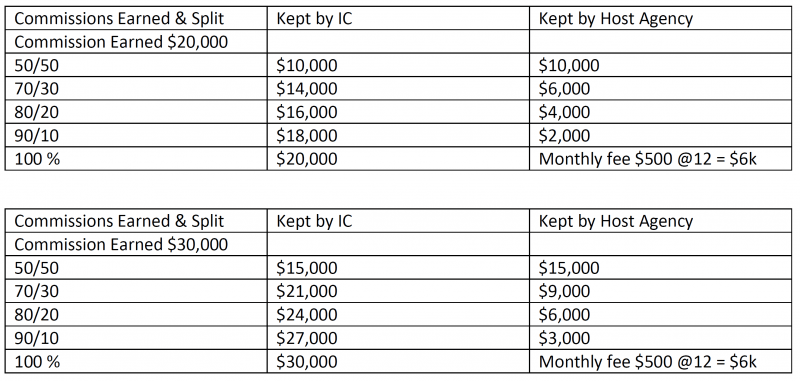
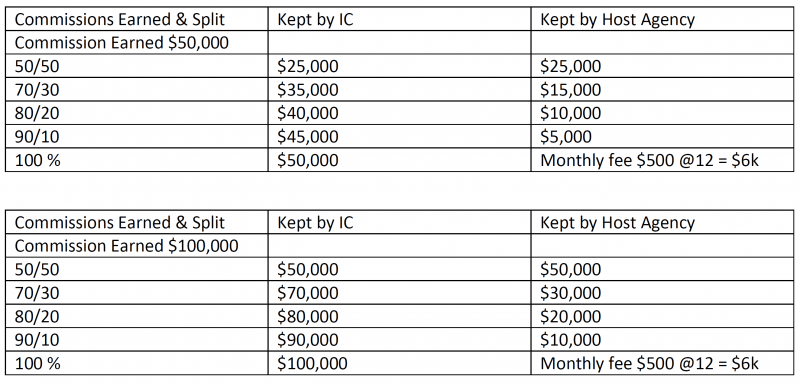
As you can see from the charts above, the monthly fee for a 100% plan is fixed and does not change with how much commission is earned by the IC. On the other hand, the amount of commission earned, and the commission split can influence the ICs profitability wildly!
If an ICs business model is to sell the products that will bring them higher commissions, it may behoove them to invest in the 100% plan, even before commission start to roll in. Remember, this is a tax-deductible business expense.
For the IC who needs training and opts for the 50/50 plan, try to negotiate your contract so that your percentage will increase as your “book of business” grows. If this is not possible, or an IC is already in this model and finds themselves giving away more commissions than they want, decide to find a better situation. Do not keep booking under the same host, or you will be digging yourself in deeper and deeper!
Knowing their numbers is an important tool that will help an IC move toward profitability! Host agencies are more important to the travel industry than ever before, and the contracts that they offer should allow them, as well as the IC to be fairly compensated.
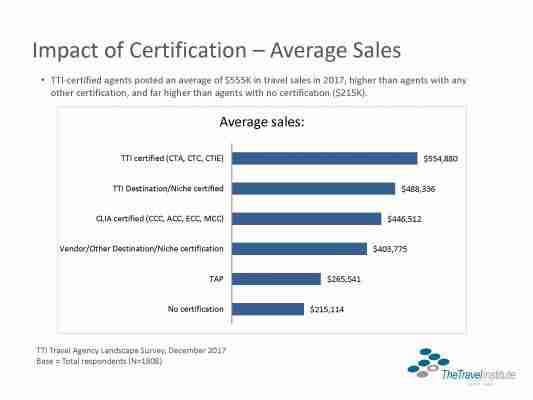
Education, (and continuing education,) can directly affect your bottom line! (viii)
Educate yourself on products and destinations you are passionate about; ignore distractors.
Just like everyone else, an IC’s most valuable, non-renewable resource is their time. Focusing in on their chosen market and only taking Educationals (FAM Trips) or trainings that align with their goals will be the best use of an IC’s limited resources.
As shown in the graphic above, those who are educated within the travel industry, are the ones who are making the most money!
In my many years in the travel industry, I have noticed a few advisors will take all Educational or FAM trips that come along just to travel. I know that travel is one of the main benefits of getting into this industry, however, indiscriminately jumping on every option that comes along is not only a bad idea for an IC as it steals their limited time, but I believe that it is also unethical. An IC should not be taking a spot on a travel partner’s trip or going to a destination, if they know they have no intention of selling it in the future! It is always best to leave those opportunities to other advisors so both they and the travel partner will benefit.
Endeavor to become a specialist in your chosen niche. Use the limited time and attention available to focus on becoming the go-to specialist. Make sure to stay up-to-date and current on the comings and goings for the destinations and travel vendors partnered with. Do not try to be all things to all people; do not waste time learning unfamiliar destinations. Instead devote more time and attention to developing relations with your company’s ideal clients. Shower them with attention and show them you care about their needs and they will rave about you to their friends and family, maybe providing one of the biggest honors that a business can ever receive, REFERRALS!
Find a mentor who is doing what you want to do, and then follow their example.
There is no reason to reinvent the wheel! Find someone you admire and let them be your guide. They may be in the same niche or may be working with the same client demographic that you want to work with. If you like what they have achieved, replicate their actions, then chances are you will find yourself with similar success.
Think about asking this person to be your mentor, hire a business coach, or join a professional mastermind. The investment in yourself and your business is not only tax deductible but will stretch you and your business! These relationships often add a level of accountability and can give you access to professionals “who have been there and done that” and are willing to help you enjoy the shortcuts they found along their path!
CONCLUSION
Key Takeaways
-
- Becoming an Independent Contractor in the Travel Industry can be a fun and rewarding first or second career when you put forth a little effort upfront.
- With its low barrier to entry, there are a lot of risks but do not let that detract you because there are also a lot of rewards. The key thing is to keep in mind is that you are a business owner and exercising an entrepreneurial mindset is essential.
- By establishing a firm foundation including smart business planning, adhering to legal regulations, and adopting industry standards, you too can enjoy a profitable career as an Independent Contactor while having fun, helping your clients, and traveling the world!
REFERENCES
(i) The Travel Institute’s study – The Changing Face of Travel Agents – May 7, 2018 Agents have shifted from working primarily as employees (71% in 2008) to working primarily as independent contractors or ICs (62% in 2017).
(ii) Travel agencies would receive travel vendor promotions by fax before emails. These faxes would then be filed into folders by category or destination. This task was often assigned to the agent with the least seniority.
(iii) You must comply with any Seller of Travel Laws in the states in which you operate your business, or to their residents to whom you sell travel.
(iv) You must comply with any Seller of Travel Laws in the states in which you operate your business, or to their residents to whom you sell travel.
(v) Priced 7/28/2020 with Royal Caribbean Cruise Line for the March 8, 2021 sailing of the Navigator of the Seas
(vi_ Avalon Waterways May 2, 2021 sailing on the Illumination. Priced 7/28/2020
(vii) IRS.gov
(viii) Income Graphic – The Travel Institute’s study – The Changing Face of Travel Agents – May 7, 2018