

Jennifer Leigh Nix, CTIE
Service fees can be an important part of the travel advisor’s business model. Along with providing consistent income when commission payments are variable, fees establish value for an advisor’s experience and education, thereby increasing credibility and professionalism for your agency.
For the advisor who has never charged service fees, there can be hesitation and fear. This hesitation may arise from years of providing free planning and advice. Fear can also arise from concerns about losing clients or deterring potential clients altogether.
We will explore why service fees are recommended, how to determine service fee structures, and how it can improve the client experience while supporting your travel business goals.
In the early days of forming my agency, I learned of planning fees through conference sessions, webinars, travel industry articles, and other advisors’ websites. Having worked as a destination manager for an expedition travel company and in the corporate sector, I was aware of the time commitment in the research, design and booking of travel.
Charging a fee in anticipation of the time spent planning a custom vacation seemed to be a natural way to get reimbursed for my efforts. Business needs change over time, so I continue to reassess my fee structure as I grow—considering factors like overhead, staffing, and client expectations.
When I launched my FIT (free/fully independent traveler) leisure business in January 2020, I don’t think any other advisers in my host agency were charging fees. Fortunately, the agency owner supported my choice to charge a fee. I knew from day one this was something I wanted to implement and remember the first Host Agency Reviews (HAR) article found, “Taking the Plunge: A Travel Agent’s Guide to Charging Fees.” The content of the article made me more comfortable in drafting my verbal content for client qualifying calls and written verbiage for the business website. Using the parallels between other service industry professionals helped to create a structure and in substantiating an industry standard rate.
There are many approaches you may take in presenting your fee to potential clients. Look to businesses with similar models as a guide when you are starting to consider your fee schedule.
Expert Recommendations from Industry Leaders
Mary Stein outlines common sense scenarios where service fees are more often appropriate:
- Air-Only Bookings:
“Leisure agents can take cues from their corporate agent counterparts and go ahead and charge a fee for air-ticketing. Booking air-only isn’t often a huge moneymaker for leisure agents. But it takes time (and sometimes causes headaches.) If a client isn’t willing to pay a ticketing fee for an air-only booking, then maybe they’re not the client for you.” - Non- or Low-Commissionable Bookings:
“If you’re booking leisure air travel, independent hotels, or smaller vendors that don’t provide a commission, this is another instance where it’s a really good idea to charge a fee.” - Booking Non-Commissionable Ancillaries or Add-Ons:
Travel advisor Ria Maratheftis from The Travel Nook said this better than I ever could, ‘If we provide personalized ‘concierge’ services such as in-depth itinerary planning with non-commissionable components, i.e. (sporting events, concerts, theatre tickets, Disney dining reservations, ride Fastpasses, wedding planning, etc.) then we will typically charge a $100 per person blanket fee to expedite the research, ticketing, shipping & ongoing maintenance.’”
“Booking FITs (or anything customized) are time-intensive and customized for your client. By nature, it takes more time to create and book FIT itineraries, and you should be compensated for that time. If you’re making any kind of non- or low-commissionable bookings (or components), I highly suggest charging a fee.”
Why charge a fee?
“The (very) short answer is that hosted advisors who charged fees earned a 42% higher income average than peers who opted not to charge a fee in 2023.”
Charging service fees is becoming the norm with nearly half of hosted travel advisors now charging fees. In 2023, the American Society of Travel Advisors (ASTA) released a credo further normalizing and encouraging professional fees.
Getting Comfortable Talking About Fees
It was a pivotal moment talking to my first client about the fee. I remember speaking with trepidation and it came out more as a question than a statement: “Um, it will be $200 for you and your husband’s week-long vacation?”
The conversation went well, and the client had no hesitation and immediately offered payment. From that point forward, I just had to practice becoming more comfortable talking with clients about the fee in person and by phone. The benefits of having a professional on their side from start to finish resonates. My now-ingrained line during the inquiry call is: “I’ll be with you from the time in which we decide to work together until you are safely home.”
Setting Fees = Setting Business Goals
When you implement your planning fee, this is also the perfect time to really dig into your business goals and how you plan to offer your services to clients. This will be key in conveying your value, which is substantiated by your experience, expertise, and trustworthiness. The benefit advisors offer to potential clients may require explanation for those who have never worked with an advisor or those who haven’t had to pay a planning fee in the past. This extra step will become less frequent as your client list grows, and your business is established.
If you currently operate without a fee, transitioning your existing clients can seem daunting. Look back at itineraries you have created, and the maintenance required to manage a few trips from start to finish. Consider the after-hours, the unexpected hiccups, and the last-minute adjustments during travel that you cannot plan for. Know that your value and being available to your clients—as well as your commitment to delivering excellent service—are worth compensation. In this review of your time, it is also helpful in assessing your current business goals and helping to strategize for the future. Use this information to create your key statements. Practice it regularly so it becomes a natural part of your inquiry calls and in the existing client transitions.
You Are Providing a Professional Service
For the content of your key statements, analyze your skill sets, reputation, and experience. Create a list of items to stress, such as your expertise, insider access, professional history, and education. This will help provide peace of mind for a potential client. On the services page of my website, I liken this cost to fees in the legal, accounting and medical professions. Most people understand they are paying for a professional service and are glad to oblige.
From 2020 to 2022, I was selling the full range of leisure travel even though the company name and focus was niche. After an analysis of client demographics, I decided to start market my company in the luxury sector in 2023. As mentioned, I started with a flat planning fee, but the dollar amount has increased, and the format has changed a few times since adjusting to my current clients, industry trends and business goals.
Focusing your efforts on obtaining the right clients will save you both time. Those that match your business model will not require convincing. With time and experience, and trial & error, you’ll learn to recognize clients who you are a good fit, and those who are better referred to a colleague. This will help you tremendously and better target your marketing efforts. With a clear goal, you will begin attracting your model clientele.
Mentorship played a critical role in my journey. Stacey Cabell—transformational speaker, founder and owner of Starstuff Travel, and member of The Travel Institute’s Professional Educators Program—regularly reminded me: “Don’t sell from your own pocket.” To elaborate, this means you shouldn’t sell yourself short whether in setting your fees or selecting a client’s travel. Match the client’s desires and consider industry trends. Reserving a boutique hotel suite and private activities might fall outside of your personal budget but perfectly aligns with a client’s vacation vision. Charging an hourly rate which may match a legal or medical professional, might feel excessive in the beginning, but is realistic when you take a close look at your average time commitment and overhead expenses. Implementing this mindset was foundational as I moved into the luxury space.
Industry Examples
In her blog post “How To Implement Travel Planning Fees That Feel Aligned & Sustain Your Business: A Case Study,” Calgary-based travel expert Caitlin Sheen offers greater support and detail on structuring your fees to match your business style and financial goals.
She shares how she transformed her business by implementing travel planning fees before it became an industry trend. From battling burnout to building a thriving boutique agency, she reveals her step-by-step process for valuing expertise and setting professional boundaries. Through candid insights and practical strategies, her story provides the blueprint for Travel Advisors ready to elevate their business model and attract clients who truly value their expertise.
“Ultimately, I wanted to have more control over my business; I wanted to run my business and not have my business run me. I always knew that I did not want to be an agent that works 12 hours a day, 7 days a week, or always working my weekends, or stressing every time I went on vacation.”
Another example is from Tami Santini, the owner of Paradise Getaways. She has a destination wedding planning business in Portage, Michigan and offers advice to travel advisors looking to scale their honeymoon and wedding agencies. Her recommended fee structure is listed in the table below based on the advisor’s tenure in the travel industry.
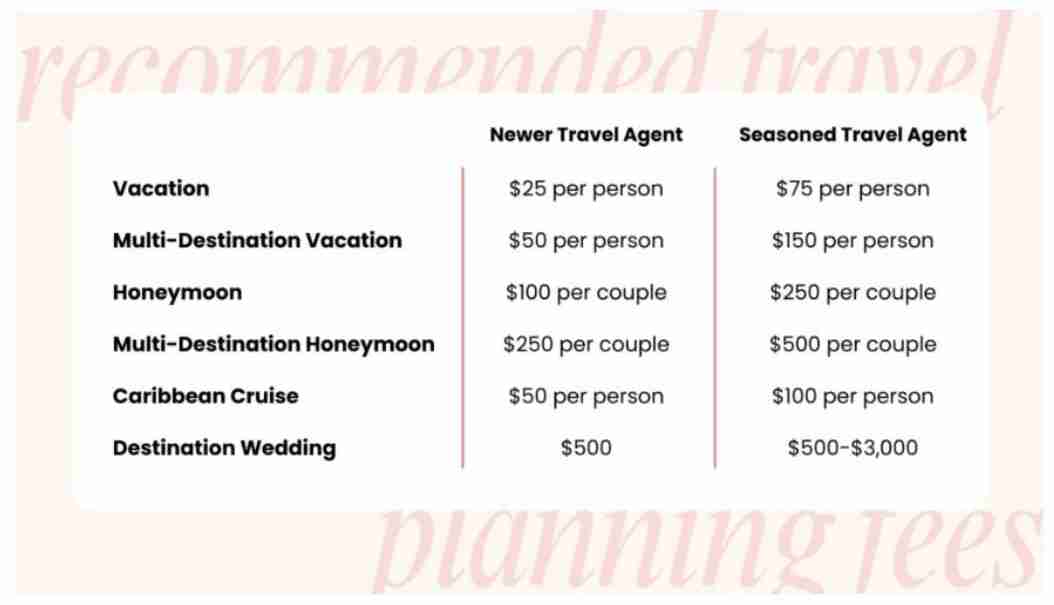
She considers the following key steps in creating a streamlined fee-based operation that contributes to: “having a great relationship with clients who will work with you for all their travel needs.”
- Step #1: Change Your Process for When You Get a Lead
- Step #2: Showcase Your Value
- Step #3: Have a Way to Invoice and Collect a Fee
Tami really hits home with this personal statement: “Something that I learned the hard way in my travel business was that unless I treated myself as a professional first, no one would.”
Using Your Voice
The next step is to create a few sentences about your services and fee structure that you are comfortable relaying in print and aloud. Be concise and practice with your family, friends, and/or colleagues. Be authentic in your approach and the response will be better received.
My industry journey from c-level executive business travel to luxury leisure required a personal rebrand. It is a shift of perspective to start focusing on yourself when the inclination is to the customer. Create and brand yourself for success and the clients will follow.
Consider these points:
- How would you want to hear from someone you are considering hiring? From someone stumbling over their words or a person with poise relaying their experience with confidence?
- I once heard someone say to smile before you initiate a phone call or enter a room for a meeting — it shines through to your audience and creates a welcoming start to your interaction.
- Confidence is key in your delivery and conveys professionalism.
When detailed information is conveyed in an upfront and transparent manner, you will be surprised how quickly clients are prepared to compensate you appropriately. As an added benefit, you are eliminating a sector of shoppers, DIYers, and tire kickers that may not be a good fit for your business.
Service fees in your business model
Service fees are recommended to support your income and provide an increased level of professionalism to your business. Commission payments can be inconsistent, so leverage your experience and education, thus increasing your and your agency’s credibility. Implementing a fee structure will improve the client experience while supporting your business’s financial stability.
For the advisor who has never charged service fees, this information can assist in empowering you to take the first step to improve your income, reputation and attract better aligned clients to your travel business.