
Marie Mabardi, CTC
FORWARD
You have heard the tale of the lumberjack, so caught up in the job that the lumberjack overlooks details to increase productivity. Overworked, busy; no time to stop and sharpen the dull blades; the lumberjack continues working and working.
As a result, excess energy exerted, and productivity compromised. Dull blades yield a time-consuming process of cutting lumber inefficiently. Productivity diminished. Frustration and inadequacy ensue. No time to stop and think.
Do not be this lumberjack.
DEFINITION:
A Standard Operating Procedure (SOP) Manual is a playbook of business activities, simple or complex, written in streamlined steps. [1] The document serves to cut waste by discovering unnecessary steps to save time and resources. Simply put, this library of knowledge is a review and record of all procedures documenting the best methods by assessing how operations are completed and how to collectively improve in a consistent manner.
Do you know that SOPs are used all around you? They are invisible and well executed. We are unaware of their presence, except when things go awry. Imagine each visit to Starbucks, each hotel visit, cruise vacation and flight, and how each is consistent. All around the world, expectations from favorite brands are uniform. Kudos to brands meticulously writing and practicing effective SOPs. Now, you will discover their not-so-secret method for success and structure confidence for your travel business, saving time and money while adding to the bottom line.
The Standard Operating Procedures (SOPs) concept, introduced by the manufacturing industry a century ago, [2] ensured factories ran efficiently, which led to cost and resource saving and increasing profits. This concept, widely practiced today, applies to all industries regardless of the business, size, or processes. Small businesses taking advantage of this proven concept make great improvements for their business.
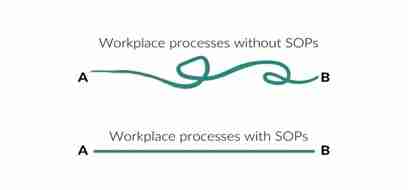
The following visual example illustrates [3] the contrast of work life without and with SOPs. Notice, there is excessive backtracking and confusion shown in without SOP example. This model translates into a loss of profits and adds frustration. Evolution into an effective direction with a professionally written SOP will happen.
1. Decreased Errors:
In possession of clear procedural instructions allowing consistency for all to follow, errors decrease. The result -bottom line saves time and money. Correcting errors is extremely expensive with time lost, and dollars shelled out. Less errors add confidence to working with the business.
2. Knowledge Retention and Sharing:
With documented procedures, knowledge is recorded and given by experienced staff. Knowledge saved, shared and most importantly, not lost when staff leave. This improves the onboarding of new personnel; new hires gain this long-held experience at the start of their tenure . This is cost-effective to the bottom line with standardization in place. The learning curve shortened, equaling bottom line savings.
3. Efficiency:
A concisely written SOP allows the team to follow instructions with clarity and achieve standard outcomes. [5] The constant need to ask questions reduced or eliminated as information guides staff and clarify procedures. Efficiency, and ending uncertainty equal bottom line savings.
4. Empowers Staff:
These plans train with the intention to empower. The written procedure allows staff to work confidently as they are working with documents clearly revealing approved steps. They have guidelines to follow and now with clear job responsibilities and accountability in hand.
5. Bottom Line:
Increased productivity and standardized services lead to an increased bottom line. Management understands tasks and has a tool to share for staff training, and reducing the error rate, thereby creating a cohesive process practiced by all staff.
As a small travel business, with razor thin profits and small staff, why bother investing time and money in this Herculean exercise? We believe we all know our duties and how to carry them out. Yet, the benefits of this exercise are endless, and become clear once carefully completed and implemented. Benefits intermingle and overlap with one another. At the end, the results will be appreciated, with the business as the benefactor.
Initiating this procedure may feel intimidating; it is not meant to be. For a travel office, it is a matter of putting experience to paper, having stakeholders agree, implementing and reviewing one or twice a year for updates and procedural changes. This recorded playbook gives inexperienced staff clarity and empowerment to follow the approved procedures and helps senior staff train junior staff. Understanding the multitude of benefits helps everyone to accept and be onboard with exact standards.
The SOP manual comes in countless forms. A check list, a flow chart, or outline, for example. Use the best format with clearly written instructions for the task at hand. It can be as simple as following this check list for opening and closing the office. We can note the goal – Office Workday Preparation and the staff position name of who is in charge.
Opening & Closing the Office (indicate leader):
1. Turn off office camera.
2. Check general office messages – pass along to personnel – see attached page with list of staff and duties to send to.
3. Review office calendar. Prepare for the day’s appointments and send staff email reminders.
4. Fill printer(s) with paper and check supplies. Order ink and paper when needed.
5. Make coffee.
6. Empty/fill dishwasher.
7. Restock snacks.
Closing the Office:
1. Check if more coffee, water bottles or snack supplies are needed.
2. Turn on the office camera.
3. Tidy office by vacuuming & emptying excess trash.
4. Run dishwasher.
5. Secure all doors and filing cabinets.
Learning Points
Created solely by a team leader, without input from the team, other ideas are missed. Someone may have included, “check for computer updates.” If there are updates, then update all computers. This procedure saves 15-30 minutes of unproductive time. Another may add, “backup computers” at the end of the workday. We cannot imagine the cost of lost information due to a host of unforeseen situations. This recommendation again yields direct savings to the bottom line. Without asking for input, staff cannot contribute, feeling it is not their place to offer advice. Simple tasks have a bottom-line effect.
For most, these tasks are obvious, why waste time making this list? When your staff is aware of their expectations, they can take part in the process. If the owner or senior staff are performing basic tasks, as they have routinely since the start of the business, they are unable to recognize the massive amount of time wasted. Spending a minimum of 15 minutes daily is equivalent to 65-man hours over the course of a year. These duties delegated to junior staff allow senior staff productivity in other areas of the travel business. These most innocuous duties have an effect when an owner or senior staff are spending the equivalent of 1.5 weeks a year completing tasks that others could easily perform. The savings of thousands of dollars will be invested in workplace applications. Again, you save time, with resources better distributed and reducing uncertainty. Meanwhile, junior staff feel good performing a job correctly according to procedure, building confidence, increases job satisfaction, and lowers employee turnover. Staff lose confidence when collaborating with an owner who is unorganized and change procedures constantly. We want our team to feel motivated and appreciated, not defeated.
To Launch:
Begin this endeavor by gathering staff from different areas and carefully review current repetitive jobs. Ask these questions: “What is the goal?” “Who and when is this performed by?”
Note anomalies that generate potential problems. A section for worst-case scenarios, with initiative-taking instructions of how to mitigate, will be a great comfort to fall back on for guidance in time of crisis. This could be as simple as a list of phone numbers of staff and suppliers to call when certain events occur, and help is needed. Procedures for incoming severe weather, last minute flight cancellations or schedule will take the angst out of determining the best way to oversee each type of incident.
Closely review, step by step, and record the process asking, “What is the best way, or how can we improve?” What saves steps, time, confusion, misinformation, and money? Keep staff engaged in the process. They have the best ideas to implement when included in the conversation. Protocol can begin with steps as simple as how to greet clients, gather information, issuing airline tickets, making travel changes, hotel and rental reservations, groups and meetings, leisure travel and correcting errors.
For staff, the benefits are innumerable. Business processes reviewed by stakeholders, streamlined, and agreed upon, remove guesswork and confusion from the equation. It is an outstanding time saver. Staff collaborate harmoniously with one another. The best practices for performing a job are no longer an issue. Procedures are vetted and agreed upon. Knowledge loss from key personnel departures is no longer a concern as their knowledge is shared and integrated in this document. New hires begin as consistently as legacy staff. Years of knowledge now survive, and nothing skips a beat.
Our Office Example:
Issuing airline tickets has become hectic. Mistakes were made with names and other pertinent information. Client requests are often written as word problems. Deciphering requests is time consuming. Names, dates of birth, cell, frequent flyer, hotel, and global entry numbers are missing or arrive incomplete. Chasing information is a timewaster and expensive, in addition to multiple emails for flight approvals and fare types (refundable or nonrefundable) and so forth. Our job is to find the best flights for clients’ requests and to buy their airline reservation with hotels and auto rentals.
Our solution: Investing in a tool called JotForm (see a partial Jotform example below), an online form that is customizable with pertinent cells for travelers to complete. One person oversees building the form and creating a link for the traveler to complete. The completed form is returned to a designated email box, with agents working on these requests. The immediate benefit is the ability to copy/paste names, cutting human error. All needed information is stored in one place, saving time searching through multiple emails. We have a written record of information. A profile is built to be prepared for the time they do send a word problem, their basic information ready.
Jotform example:
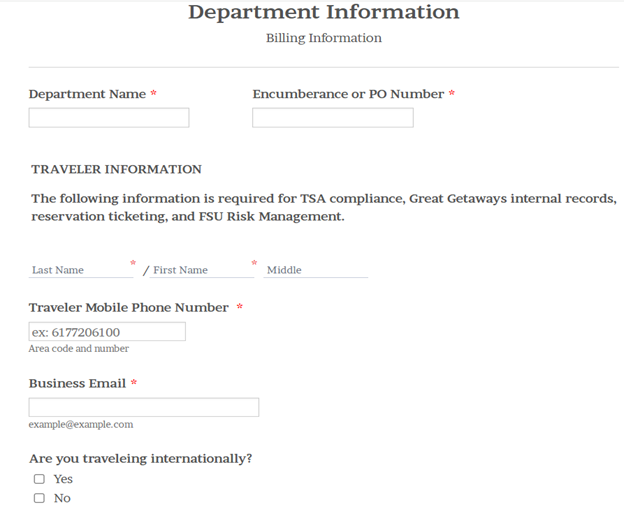
In the beginning, we believed only one form would be necessary. We were quite wrong; a substantial number of forms are necessary. This saves the client time as they can send the link to individual travelers allowing them to step away from gathering everyone’s information. Customized forms are made for separate groups and events of people traveling together. These forms give us the ability to ask for preferred departure times, which aids in narrowing our suggestions for flights.
SOP Airline reservations:
1. Travel arrangements are requested.
2. Agency sends a link to complete.
3. Passenger completes link and returns.
4. The agent builds a reservation with this information and provides flights for approval.
5. A SABRE profile is made.
6. Passengers approve flights by email.
7. Airline tickets are purchased.
8. The final itinerary is sent to the proper personnel.
Clients will appreciate service consistency with newfound confidence leading to increased business and trust. This is especially true if the business has been inconsistent with service levels such as not meeting target dates, and inconsistent responses to queries or errors. A well planned and executed SOP will reduce these problems.
Bottomline savings come in the form of reduced errors, increased staff confidence, productivity and teams working toward the same goals and mission. Errors undermine confidence in service for clients and staff. An SOP examines where and why errors occur, and how to reduce and end these problems. Meticulous examination of a process is necessary to pinpoint holes that cause glitches and lost time. Examining all types of errors and setting up processes to reduce, eliminate, and improve the bottom-line, gives staff confidence and a sense of relief, and reduces stress.
Imagine your favorite brands without an SOP. This is the potential for horror shows with each location inconsistent with one another. For leisure travel consultants, the SOP is different and has specific processes depending on where in the sales cycle they are. For a new inquiry/sale, the tasks could be the following.
New Sale:
A new sale has intricacies; it takes time for these details and step to become second nature. Each trip is unique and requires planning flexibility within the steps. These steps illustrate the general thought process to follow. Note that there are back-office steps and client forward steps. If the office has a marketing department, add how the client found us. Did they respond to a social media post or are they a referral? If a referral, who may we thank?
1. Verify guests’ names and DOB to passport name and vendor’s confirmation for accuracy.
2. Start email folder for client.
3. Send an email to guests about travel protection advising if declined, travel arrangements are nonrefundable for any last-minute changes or cancellations. Office is not responsible nor liable for any refunds.
4. Compose an email that summarizes travel arrangements and has guests verify name(s) dates, location, and arrangements. They must approve the trip as said and approve use of their card for deposit and final payment.
5. Start a GDS reservation with all pertinent information from travel dates, flights, and supplier. Note: supplier phone and confirmation numbers and payment due dates.
6. Set a reminder 2 weeks in advance of deposit and final payment due dates.
7. Send an introduction to the District Sales Manager or hotel rep for upgrades and VIP courtesies.
8. Verify all arrangements and pricing.
9. Send the client a Thank You letter for choosing your office to manage their vacation.
10. Remind client to complete any online check-in, if needed.
11. Communicate with client 1 week prior to departure to answer questions and review details.
12. Send a text to verify if further help is needed.
13. Send a welcome home email three days after returning.
14. Send supplier an email about guest’s experience.
For a destination wedding party or a group traveling on a cruise, there are more details to arrange and to verify with the guests and the supplier. For guests – utmost importance of legalities from name, citizenship, visa, date of birth as well as cell and email information for each person. For Supplier, verify they have rooms arranged as asked for, and are there welcome gifts placed in each room. See that upgrades have are made for group leaders.
Below is an approach a travel management company may use for issuing airline tickets, reserving hotels, and rentals.
Answers to questions should follow policy.
1. Issuing Airline tickets – goal 100% accuracy.
a. Accuracy of personal details – how this is communicated, stored & retrieved.
Who manages creating and updating?
b. Accuracy of travel dates, location, and time.
How is information received?
c. Communicating information to travelers.
How is it sent? What questions are asked?
d. Does scheduling and pricing follow company policy?
e. Fares – buy refundable, nonrefundable, basic, or premium?
f. Are seat assignments available? Are premium seats approved?
g. What is the procedure for changes made by travelers and airlines after departure-what is the procedure? How is this communicated to travelers?
h. Wrong travel arrangements – what is the procedure for correction? Incorrect information from travelers or agents? Type of error – dates, name, or location?
i. Weather/natural disaster -proactive initiatives to help travelers?
2. Hotel and rental reservations- 100% accuracy.
a. Was the hotel name provided, or location given?
b. Does hotel meet the need of traveler?
c. Has traveler approved of hotel and rate?
d. Do hotel rates follow policy rates? If not, do traveler acknowledge and have approval?
e. Who is paying for hotel rooms?
3. Bidding meeting room block.
a. How are the details provided by the client?
b. What concessions are given?
c. If clients do not use allocated room block; to whom is this communicated?
d. Has attrition been clearly communicated to clients in writing and approved?
e. Who is paying for room block?
f. Is the meeting space needed?
g. Who will audit the final master bill?
4. Reading and signing contracts.
a. Who manages reviewing the contract?
b. Who is responsible for signing the contract?
c. How are cancellation policies communicated to the client?
d. Procedure if hotel walks guest.
5. Coordinating Logistics
a. Are private drivers and vehicles needed?
b. Who will pay for transportation?
c. Who is assigned to coordinate airport arrivals for van service?
At the beginning, an SOP serves as checklists to:
• Work in the most efficient way possible.
• Monitor and improve performance.
• Ensure the team knows what to do when the unexpected occurs.
Writing the SOP is as important as its implementation. Its success requires stakeholders’ acceptance and full participation. While it is difficult to derive an exact cost/loss value for not using this method, not doing so will risk daily procedures not functioning smoothly. This process will allow the business to avoid the frustration of time wasted repeating, cleaning up and trying again. Implementing this process, I believe, there is a minimum savings of 20% of time and money. This is significant for all businesses. When procedures are thought out and executed as a team, the business will have the steps in place to grow and keep up with the pace.
Look forward to a less stressful work life. This ideology is the first step in your well-organized business. It is ready and waiting for your input. A new beginning of increased productivity, now giving time to focus and explore new business avenues with newfound time and income.
Take the necessary time to sharpen your blade and get ready for the amazing results to follow.
NOTES:
[1] (Nolan, 2024 ) https://www.britannica.com/topic/standard-operating-procedure
[2] https://www.britannica.com/topic/standard-operating-procedure
[3] (Gloria, 2021) https://www.swipeguide.com/insights/5-reasons-why-you-need-standard-operating-procedures
[4] (Gloria,2021) https://scribehow.com/library/benefits-of-sops
[5] https://simpleflying.com/airline-standard-operating-procedures-explained/
Bibliography
Gloria. (2021, december 21). https://www.swipeguide.com/insights/5-reasons-why-you-need-standard-operating-procedures. Retrieved from swipeguide: https://www.swipeguide.com/insights/5-reasons-why-you-need-standard-operating-procedures
Jack Herstam. (2023, February 26). Simply Flying. Retrieved from https://simpleflying.com/airline-standard-operating-procedures-explained/
Nolan, J. (2024, December 25). https://www.britannica.com/topic/standard-operating-procedure. Retrieved from Britannica: https://www.britannica.com/topic/standard-operating-procedure